 Este artigo foi escrito originalmente em inglês.
 Ler em Português
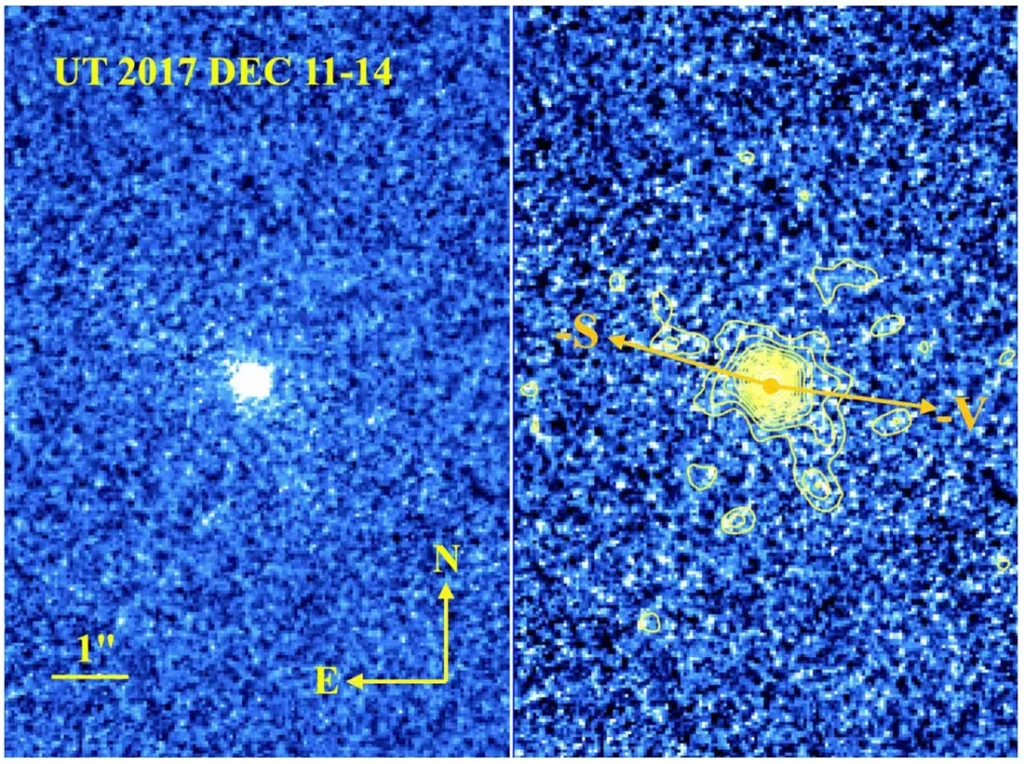
In a new paper published here, the accomplished astronomer David Jewitt reported about an unprecedented behavior of the Jupiter-family comet 41P/Tuttle-Giacobini-Kresák. The report uses archival data collected by the Hubble Space Telescope on December 11–14, 2017, coincidentally about a month after the discovery of the interstellar object 1I/`Oumuamua. This comet, which likely originated in the Kuiper Belt and was flung into its current trajectory by Jupiter’s gravity, is now visiting the inner solar system every 5.4 years.
It is well known that the spin of cometary nuclei changes as a result of the rocket effect from torques induced by outgassing. The nucleus of 41P/Tuttle-Giacobini-Kresák exhibited dramatic rotational changes when it passed near the Sun in April 2017. Eight months later, the combination of Hubble imaging and measurement of non-gravitational acceleration implies a nucleus diameter of about a kilometer (± 200 meters). Systematic brightness variations are consistent with a rotation period of 0.60 (± 0.01) days, substantially different from periods measured earlier in 2017.
Data from NASA’s Neil Gehrels Swift Observatory in May 2017 implies that the object was spinning three times slower than in March 2017 when it was observed by the Discovery Channel Telescope at Lowell Observatory in Arizona. The Hubble images from December 2017 detected the comet spinning much faster again, with a period of approximately 14 hours, compared to the 46 to 60 hours measured by Swift. The simplest explanation is that the comet continued slowing until it almost stopped, and was then forced to spin in the near-opposite direction by outgassing jets from its surface — induced by solar illumination of surface ice. Jets of gas streaming off the sublimated pockets of ice can act like thrusters and if these jets are unevenly distributed, they can change the spin of the comet.
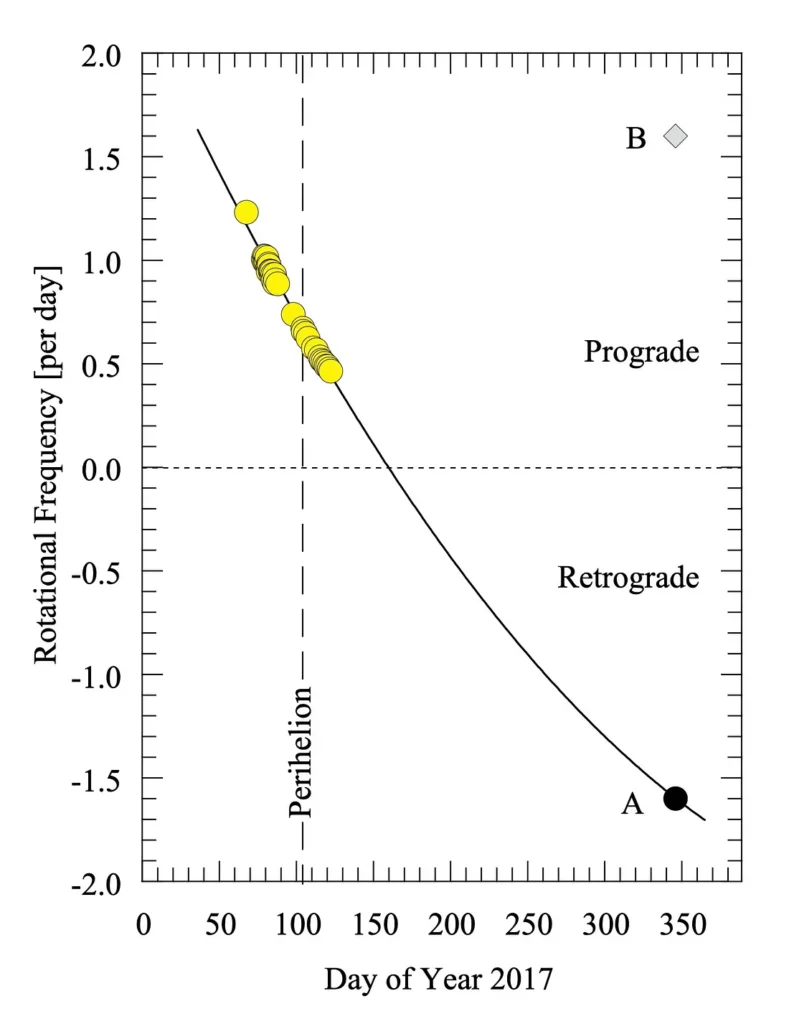
The spin of the nucleus likely reversed between perihelion in April 2017 and the post-perihelion observations in December 2017 as a result of torque from outgassing jets. The brightness variations indicate a projected axis ratio of about 1.4 to 1, while the active fraction of the nucleus decreased by a factor of 17.
The time for this small nucleus to spin up is short compared to the reported dynamical time spent in the current orbit — which is estimated to be about 1,500 years. The inferred mass loss rate from outgassing means that the object should have evaporated or broken up by rapid rotation long ago. Its observed activity should have destroyed it.
As a result, the data constitutes a major puzzle: how did the object survive over the long lifespan of its orbit?
Jewitt suggests two possible explanations to this puzzle. The nucleus could have been observed by the Hubble telescope during a state of unusually strong activity, leading to an overestimate of the average mass-loss rate and outgassing torque and resulting in an underestimate of its physical lifetime. Alternatively, the nucleus could be the surviving remnant of a larger body for which outgassing torques were less effective.
But there is a third possible interpretation. Perhaps 41P/Tuttle-Giacobini-Kresák is a Trojan Horse with the outside appearance of a natural iceberg but with technology embedded in its belly.
In that case, its spin reversal is a technological signature. Based on my personal experience — if Jewitt have discussed this technological possibility, his paper would have been blocked from publication. Indeed, this possibility is not mentioned in the published paper, but I am free to mention it here in the absence of gatekeepers — within the safe space of my essay.
Whether spin reversal is a technological signature or not, the Hubble data from 2017 on 41P/Tuttle-Giacobini-Kresák constitutes the first reported evidence for an apparent spin reversal of a comet.