Este artigo foi escrito originalmente em inglês.
 Ler em Português
Two papers that I co-authored in 2015 here and here with my brilliant postdoc, James Guillochon, showed that there exists a population of relativistic stars traveling throughout intergalactic space after being ejected by black hole pairs in galaxy mergers.
For more than a century, conventional wisdom has been that stars are born in galaxies. Over the past two decades, it became clear that some stars are ejected out of galaxies when pairs of stars arrive too close to the central supermassive black hole. In 1988, the astronomer Jack Hills realized theoretically here that the strong tidal gravity of the black hole can break the binary star system, sending one star to a tighter orbit around the black hole while the second is expelled beyond the escape speed from the host galaxy. Such hypervelocity stars, with an ejection speed of thousands of kilometers per second, were first discovered two decades later in a paper published here by Warren Brown and collaborators from the Harvard-Smithsonian Center for Astrophysics. It has also been recognized theoretically here that hypervelocity stars can also be ejected by pairs of supermassive black holes that act as gravitational slingshots.
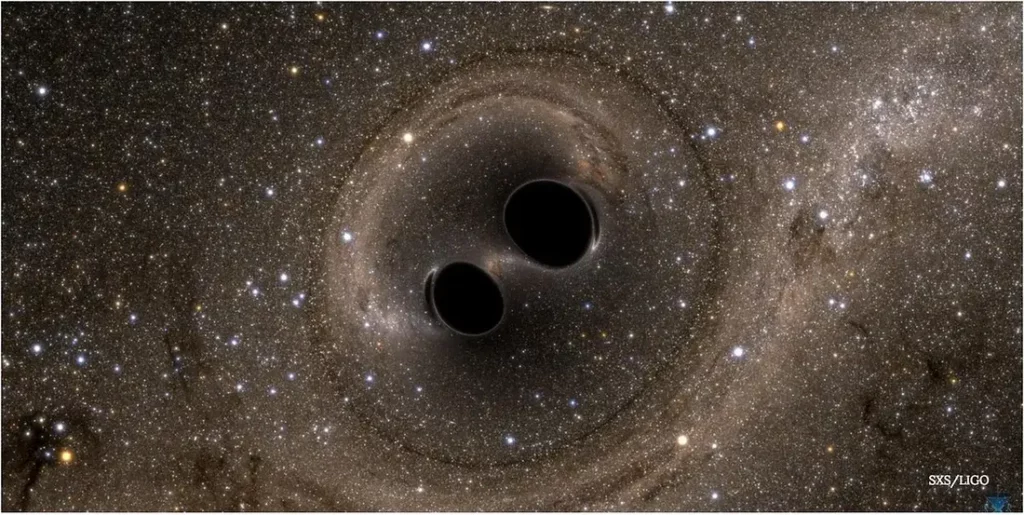
Most galaxies harbor massive black holes in their cores, and when two galaxies merge those black holes end up orbiting in a tight bound configuration leading to a final merger. The complex gravitational interplay between the pair and a neighboring star could lead to ejection of the star with a huge speed.
If the black holes are in a tight, highly eccentric orbit, the ejected star can reach a substantial fraction of the speed of light. In our 2015 papers, James and I found that in massive black hole mergers, stars which are originally bound to the secondary (lower mass companion) black hole are frequently ejected with velocity between 3% and 50% of the speed of light. These “semi-relativistic” hypervelocity stars (SHSs) escape from their parent galaxy to intergalactic space and could cross a significant fraction of the observable universe (tens of billions of light years) in the time that elapsed since their ejection. Our two papers demonstrated that if a significant fraction of black-hole mergers undergoes a phase in which their orbital eccentricity is above 0.5 and their closest distance is tens of the primary’s Schwarzschild radius, the space density of fast-moving stars may be as large as hundreds inside the Milky-Way’s distance from the Andromeda galaxy. We calculated that there should be more than a trillion stars in the observable universe moving at velocities of more than a tenth the speed of light, namely 67 million m.p.h. (108 million kilometers per hour). About ten million of those stars are moving at least five times faster than that.
A decade ago, James and I were hoping that our theoretical predictions would be validated observationally. Cosmologists have studied the expansion history of the Universe by detecting speed-of-light particles in telescopes and sensors. These particles included primarily photons of light, but also neutrinos and gravitational waves. Semi-relativistic stars would be a new type of luminous “particles,” which — once detected — would give us the opportunity to do cosmology in an entirely new way. Since they move slower than light, they can be used to measure cosmological distances as a function of travel time in a novel way across the universe, as explained here.
As the intergalactic stars fly across the Universe, their trajectories are bent by the gravity of galaxies they pass along the way like a ball moving through a pinball machine. If we can reconstruct their trajectories back to their original host galaxies, we can test whether gravity acts according to Einstein’s General Relativity.
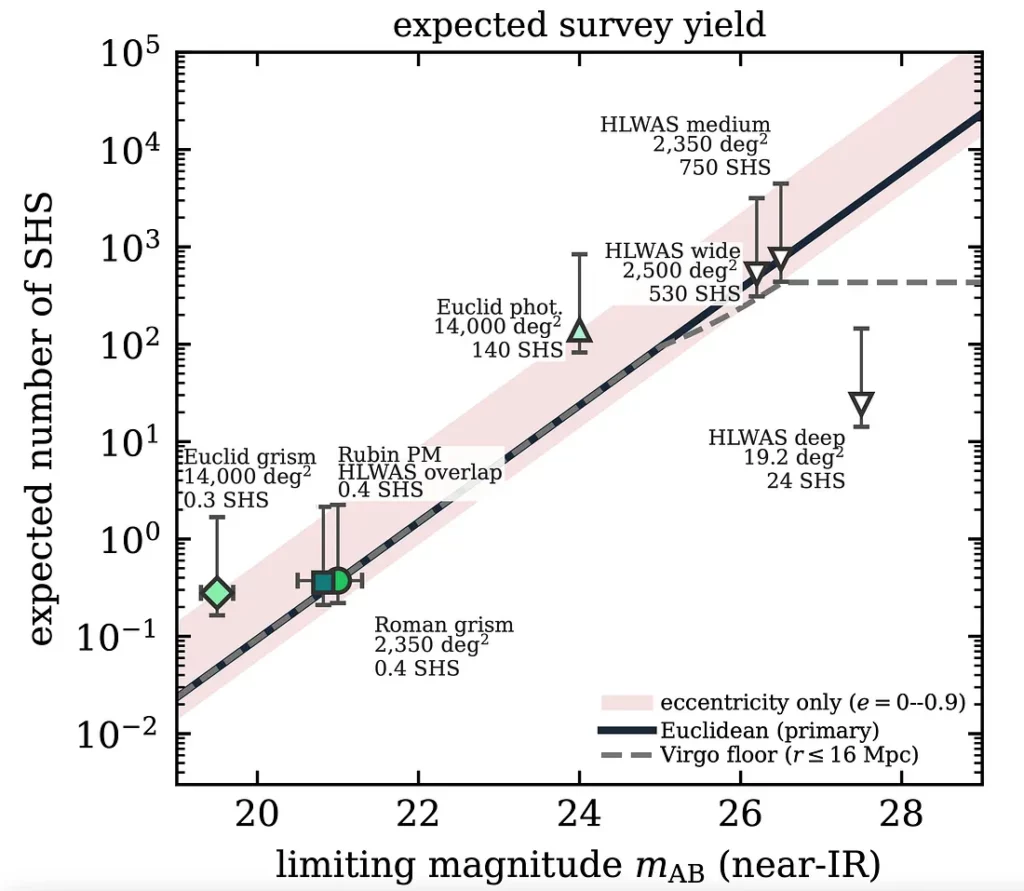
Today, James and I posted here a follow-up paper in which we show that the recently launched Euclid and Roman space telescopes provide near-infrared imaging capabilities for photometric hyper fast star candidates, and spectroscopy that verifies the bright tail of the population of stars. Euclid’s Wide Survey could yield about 140 photometric detections over 14,000 square degrees, while Roman’s High-Latitude Wide-Area Survey goes deeper, yielding hundreds of semi-relativistic hypervelocity stars. A blue-shifted spectrum would verify a hyper fast star; a proper motion large for that distance with no parallax would solidify the discovery.
The ejected semi-relativistic stars need not be on their own. They could be intergalactic stars with planets around them. If these planets are habitable, they offer the most exhilarating roller-coaster rides in the Universe. While none of this can happen in our own galaxy at the moment, our sister galaxy Andromeda is slowly approaching the Milky Way. In a few billion years, the two galaxies will likely merge based on a paper that I published here in 2008 with my postdoc then, T.J. Cox. After the merger, the resulting Milkomeda galaxy will host a twin black hole system near its center. This nearby gravitational slingshot will shoot stars out to intergalactic space at a substantial fraction of the speed of light.
Tickets for these trips should be offered at a high price by intergalactic tourist agencies throughout our galaxy.