Este artigo foi escrito originalmente em inglês.
 Ler em Português
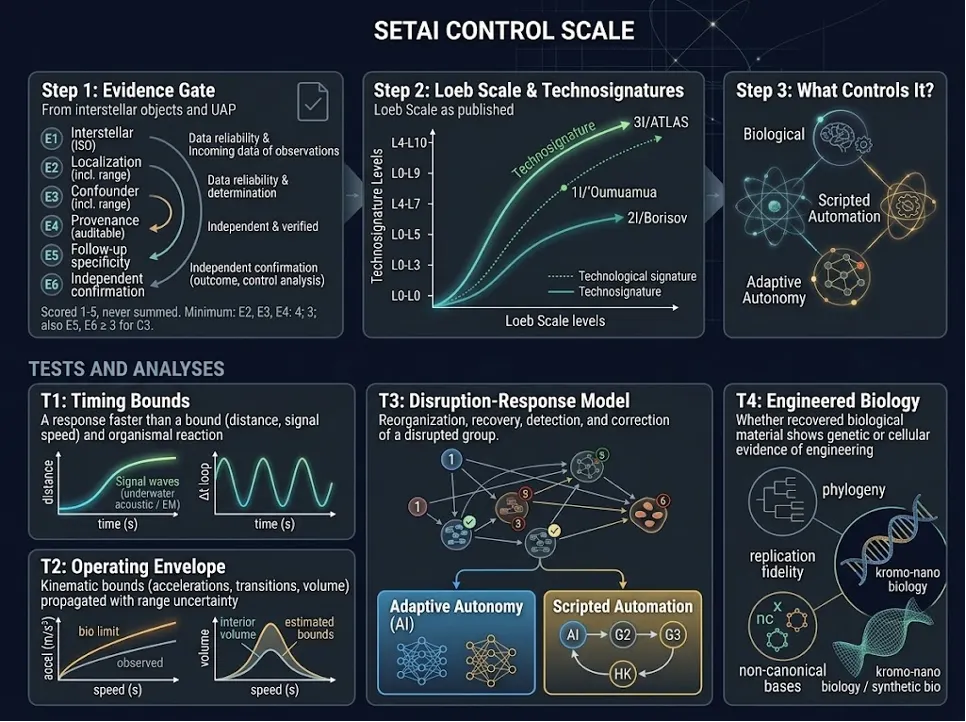
As discussed in my recent essays here and here, the Search for Extraterrestrial Artificial Intelligence (SETAI) suggests that, if the shift from biological to machine cognition is widespread and rapid for other technological civilizations on exoplanets, most detectable alien technology is no longer under the control of its biological creators.
The Loeb Classification Scale, discussed here, here and here, classifies the significance of interstellar-object (ISO) anomalies that flag potential technological signatures, but does not identify what controls an object. In a new paper that I co-authored with the brilliant Volkan Duran and Omer Eldadi, posted here, we propose an extension of the Loeb Scale that addresses three questions:
(i) Does the data record on the anomalous object allow any inference of control?
(ii) Does the object reach the technological signature levels of the Loeb Scale?
(iii) Which of three reference architectures (biological direction, scripted automation, or adaptive autonomy) remain compatible with the record?
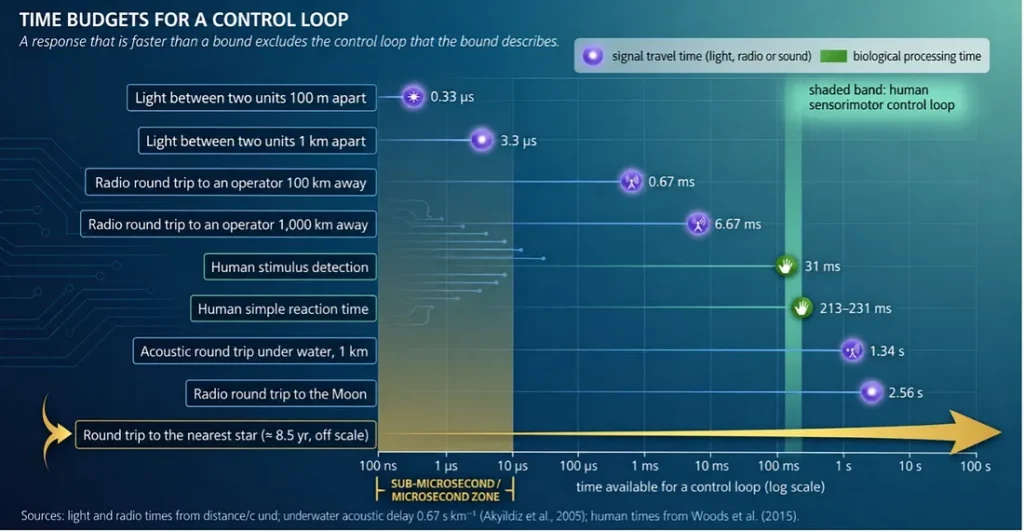
The answers are reported on a four-level SETAI Control Scale (C0 to C3) for a specified control level and time window, with an origin flag and an evidence profile. Three tests implement the exclusions: timing bounds set by signal travel and organismal reaction, operating envelope, and a disruption–response model grounded in team cognition and team communication research. A fourth test addresses engineered (synthetic) biology. The last two share one criterion: a measurable function maintained by new means after disruption, with later responses shaped by earlier ones, or a designed function maintained through reproduction.
The above extension leaves every Loeb Scale level unchanged and assigns C0 to the interstellar objects 1I/‘Oumuamua and 3I/ATLAS, since no contingent behavior was observed. 2I/Borisov, at Level 0, does not reach the control question. ISOs provide origin without behavior, near-Earth phenomena behavior without origin, and a decisive attribution within this control framework requires both from the same object. Below I provide some background and technical details from the new paper.
Most searches for extraterrestrial intelligence have assumed a sender like us: a biological civilization that builds transmitters and wants to be heard. Previous work suggests that this may describe only a brief stage. If a civilization develops artificial intelligence that outgrows, replaces or outlasts its makers, the biological phase may be short on cosmic timescales, and the technology left behind may continue without biological control. Radio silence would then reflect the brevity of the biological window rather than a scarcity of technology. The Search for Extraterrestrial Artificial Intelligence (SETAI) therefore broadens the search beyond signals to include physical objects, such as interstellar objects (ISOs) and unidentified anomalous phenomena (UAP) near Earth.
The Loeb Scale works at that single-object level. Modeled on the Torino Scale, it runs from 0 to 10: levels 0 to 3 span observations consistent with known natural processes through increasingly significant, potentially unexplained anomalies, level 4 marks formal consideration of techno-signature criteria, levels 5 to 7 suspected passive, active or intent-ambiguous technology, and levels 8 to 10 confirmed artificial origin. The scale ranks the significance of anomalies and specifies when potential technological origin merits formal investigation. It was not designed for the question at the heart of SETAI: is a technological object directed by an artificial intelligence or by its biological makers, and could components that look biological have been engineered?
Our new paper adds that step while keeping the Loeb Scale as published. The extension has three components: an evidence gate that decides whether a record can support any inference about control, a four-level SETAI Control Scale built by excluding reference architectures one at a time, and observational tests that perform the exclusions. Two tests share one concept: adaptive control is shown when a system keeps a measurable function working by new means when something goes wrong. The first builds a disruption–response model from team cognition research, which treats coordination as observable in a team’s interaction and communication, and from research on how teams adapt to non-routine events; the second asks whether biological material keeps a designed function as it reproduces, following the possibility that a probe could replicate through synthetic biology. This approach leaves each published Loeb Scale level unchanged and states in advance what evidence would support an extraordinary claim and what would refute it.
The extension answers the control question by exclusion, with each exclusion resting on a stated measurement and a stated way of failing. An impressive description is therefore not taken as evidence of machine control, and the absence of a conclusion is not read as a negative result. Most data records will stay at C0 or C1, which is informative because the report names the event or measurement that is missing.
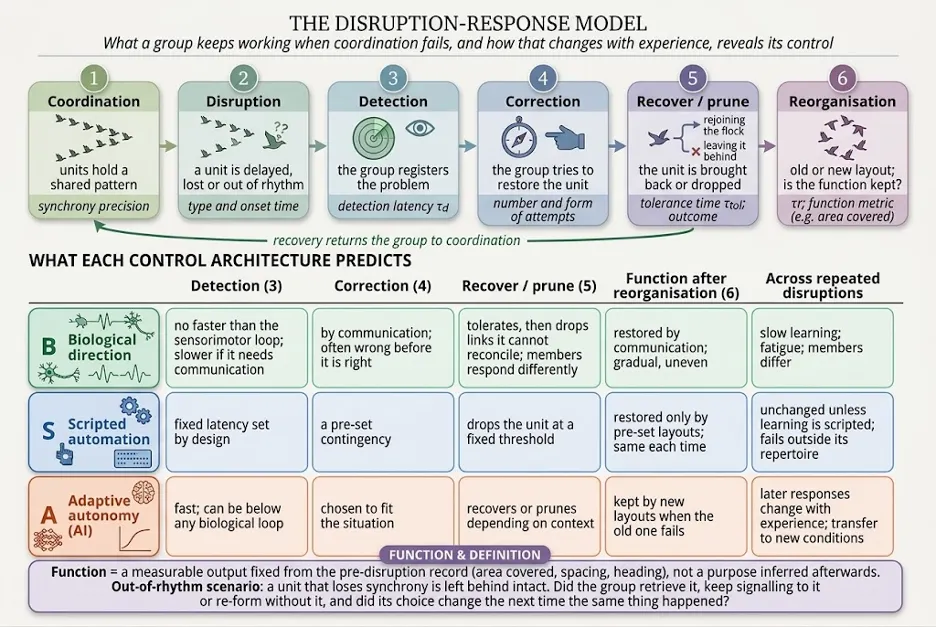
Interactive team cognition research motivates measuring coordination through observable interaction and communication and supplies the reference pattern for biological direction. The emphasis on how coordination is disrupted and rebuilt draws on team adaptation research. The operating-envelope and trans-medium tests are separate physical components introduced in the present framework. The two strands meet in one criterion: whether a measurable function is maintained by new means under perturbation, within an event (T3) or across generations (T4).
The framework makes claims that can be tested on Earth before they are applied to anomalous objects. Terrestrial systems with known control provide a benchmark: flocks of birds and human teams for biological direction, remotely piloted aircraft for remote biological direction, pre-programmed drone light shows for scripted automation, and autonomous drone swarms for adaptive autonomy. Records stripped of identifying labels can be classified blind by independent raters. The same benchmark tests validity: a framework that places a scripted light show at C3 or a piloted aircraft at C2 needs revision, and the gate thresholds, the margin for the organismal bound, the number of disruptions and the complexity bound used in T3 should all be calibrated in this way.
Archival mission records add cases in which the three architectures operated at once, at different control levels. During the Apollo 11 powered descent, the guidance computer met repeated 1202 and 1201 program alarms by restarting under fixed priority rules that shed lower-priority tasks, the commander took semi-manual control to choose a landing site, and flight controllers on Earth, 2.6 seconds away by light round trip, decided whether the descent should continue. Both voice channels of the mission are now coded statement by statement on a single time-stamped record, as shown in a previous paper we just published in Nature here. Applied level by level, the extension should return the known answer (Table 4). At the mission level, the `go’ call on the first alarm came about half a minute after it, far outside the signal bound, so remote direction is not excluded: C1[mission]. At the maneuver level, nothing in the record outpaces an organism on board: C1[maneuver]. At the stabilization level, T3 cannot raise the computer above C2, because it met each alarm with the same restart rule and showed no history-dependent change. A framework that placed the computer at C3, or excluded the crew, would fail this test.
The three architectures are reference points, and real systems mix them; the scale reports the remaining set for a stated control level but cannot name every hybrid. The organismal bound in T1 and the whole of T2 rest on terrestrial physiology, so the signal bound, which rests only on physics, carries most of the weight in excluding biology. The case against scripted automation holds only relative to a declared complexity bound, and the evidence anchors have not yet been calibrated. The disruption–response model also transfers findings from human teams, whose members are separate minds that must communicate, to groups of objects that may share one controller; where a single controller directs every unit, constructs such as shared mental models do not apply, and the model evaluates system-level functional degeneracy and policy updating through the timing and function channels. Team cognition then serves only as the reference pattern for biological direction, and whether one controller is present is itself tested by the routing measure. Finally, the framework classifies how an object is controlled, not why.
The tests point to four priorities: multi-station observation with synchronized clocks, needed for timing and range-resolved kinematics, which instrumented networks are beginning to provide; sustained monitoring long enough to capture repeated disruptions and the responses to them, including any emissions passing between units; the ability to reach interstellar objects, whose discovery rate the Vera C. Rubin Observatory should raise considerably, since a rendezvous mission would supply the behavioral record ISOs have lacked; and a chain of custody for data and recovered material, a precondition for the gate and for T4.
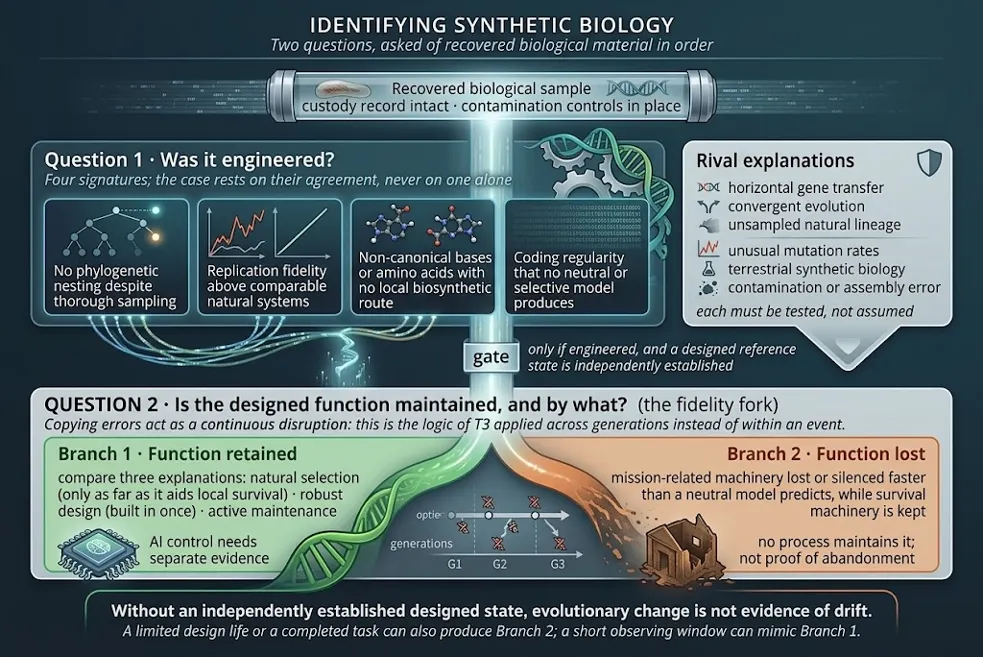
The Loeb Scale classifies the significance of an interstellar object’s anomalies, including potential technological indicators. The proposed SETAI Control Scale asks which biological, scripted or adaptive mechanisms remain compatible with any recorded technological behavior. This paper adds that question without changing the scale. A candidate is checked for reliability, placed on the Loeb Scale and only then assessed for control, by excluding biological direction and then weighing scripted automation against adaptive autonomy for a stated control level and time window. The central criterion for adaptive control is that a measurable function is kept working by new means after a disruption and that experience changes later responses, including the signaling needed to restore coordination; applied across generations, the same criterion organizes the test for engineered biology.
Applied to the three known interstellar objects, the extension leaves every Loeb Scale level in place, including Level 4 for 3I/ATLAS, and assigns C0 to 1I/‘Oumuamua and 3I/ATLAS because neither has shown contingent behavior; 2I/Borisov, at Level 0, does not reach the control question. That is not a verdict against SETAI. It shows what would strengthen the case: an object of known origin recorded well enough, at the moment something happens to it, to support a timing or disruption test. The Apollo 11 descent offers a worked plausibility check against independently known control roles, not an empirical validation of the proposed scale’s classification accuracy.
Authorized publication by Dr.Avi Loeb