Este artigo foi escrito originalmente em inglês.
 Ler em Português

If you live in a house, one out of billions of other houses on your street, it is most likely that you do not have the best living conditions. This logic should apply to habitable worlds around stars in our cosmic neighborhood.

The class of exoplanets more conducive to life than Earth, are labeled superhabitable worlds. They offer ideal vacation destinations for interstellar travel agencies. If we ever meet aliens from superhabitable planets, they can tell us all about the paradise exoplanets on which they were born. This will likely make us jealous but should not catch us by surprise.
Is there a better host star than our Sun?
OBAFGKM is the Harvard spectral classification system used by astronomers to categorize stars by their surface temperature, moving from hottest (O) to coolest (M). This system was developed at the turn of the 20th century by pioneering Harvard astronomers, including Annie Jump Cannon and Williamina Fleming. They reordered an earlier, confusing alphabetical system based on hydrogen line strength into a smooth sequence reflecting effective surface temperature. A popular, classic mnemonic used to remember the sequence is “Oh, Be A Fine Girl/Guy, Kiss Me”.

The Sun is a main sequence G-dwarf star. Orange K-dwarf stars are cooler, smaller and dimmer than our yellow Sun and their slow burning allows them to shine for 50–100 billion years. Yet lower-mass stars, named M-dwarfs, have powerful flares that can sporadically sterilize Earth-size planets in the so-called Habitable Zone where liquid water may exist on a planetary surface. The longevity of K-dwarfs, along with their relatively stable radiation output, provides a more benign environment for planets to develop and sustain atmospheres on geological timescales.

K-dwarfs have surface temperatures between 3700 and 5,200 degrees Kelvin compared to the Sun’s 5,772 degrees, and luminosities that are between 8% and 60% of the Solar luminosity. They are more abundant by 50% than Sun-like stars.

Laboratory experiments (reported here) have confirmed that photosynthetic organisms can successfully grow under simulated K-dwarf star radiation. A superhabitable planet would be larger by 20–30% and twice as massive as Earth to retain a thicker atmosphere, providing the necessary mass and energy to support a more extensive biosphere and support plate tectonics. In addition, the bigger iron core might lead to a stronger magnetic field which would protect the planet from harmful cosmic-rays and stellar winds, and preserve its atmosphere as a womb for carbon-based life in liquid water.
A paper posted here suggests that photosynthesis can nurture life on planets orbiting these orange stars better than for Earth around the sun. The results indicate that planets orbiting K-dwarfs, receiving 80% of Earth’s solar flux, are optimal for life. These superhabitable planets sustain temperate surfaces with moderate CO2 levels. They are also easier to observe, requiring fewer transits for biosignature detection compared to Earth-like planets around Sun-like stars.

A superhabitable world with an atmosphere would be located at the right distance from its K-dwarf star for liquid water to flow on its surface. The stronger gravity would maintain a thicker atmosphere than that on Earth, resulting in a warmer and more stable climate, fueling the growth of extraterrestrial plants and animals. The stronger gravity would also make the planet rounder with opportunities for biodiversity at the intersection of rocks and water.
The present-day search for life on exoplanets is based on looking for the molecular fingerprints of biological activity in their atmospheres. The Webb Telescope can at best probe the atmospheres of rocky planets around M-dwarfs, which so far appeared as bare rocks. Probing superhabitable planets around K-dwarfs may become feasible with the next generation of large telescopes like the Extremely Large Telescope, the Giant Magellan Telescope or the Habitable World Observatory, in the coming decades.

Of course, paradise exoplanets are not necessarily the places where the infrastructure of the most advanced technological civilizations may be found. The civilizations that crossed the artificial intelligence singularity are more likely to have their data centers and AI infrastructure closer to the host star than the Habitable Zone.
In the context of the Search for Extraterrestrial AI, which I labeled SETAI here and here, I am proposing to define the `Technological Zone’ as the closest distance from the host star where an advanced technological civilization can harvest the highest flux from its host star without its technological infrastructure being compromised by the immense heat. The stellar radiation can be captured by photovoltaic cells on the surface of a hot exoplanet or an artificial space platform, with the sensitive operating system residing underground at cooler temperatures. This `Technological Zone’ could be up to tens of times closer to the host star than the `Habitable Zone’ for biological activity.

Since the surface gravity of superhabitable worlds is 20–30% larger than Earth’s, the escape speed from them is about 14 kilometers per second compared to Earth’s 11.2 kilometers per second. This requires any space program on these larger exoplanets to use a fuel mass that is at least twice larger than that on Earth. For chemical rocket fuel with an exhaust speed of 4.5 kilometers per second, the initial rocket mass (payload plus fuel) must be at least 23 times larger than the final (payload) mass, not counting the extra fuel necessary to overcome the enhanced drag in the thicker atmosphere of the superhabitable planet. As far as NASA, ESO and JAXA are concerned, Earth is a better world.
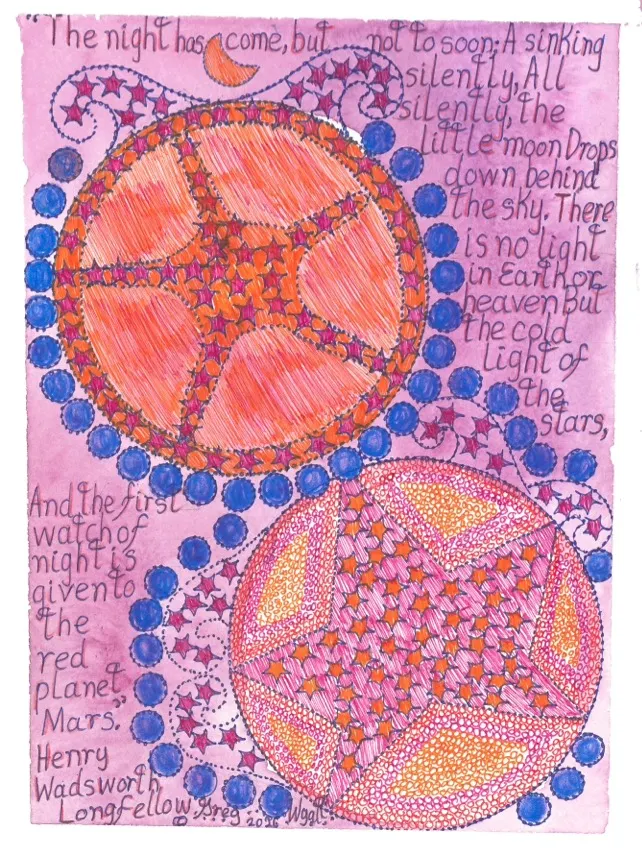
In this essay, I featured nine amazingly beautiful watercolors from a series created and sent to me by the celebrated artist, Greg Wyatt.
Authorized publication by Dr.Avi Loeb