Este artigo foi escrito originalmente em inglês.
 Ler em Português
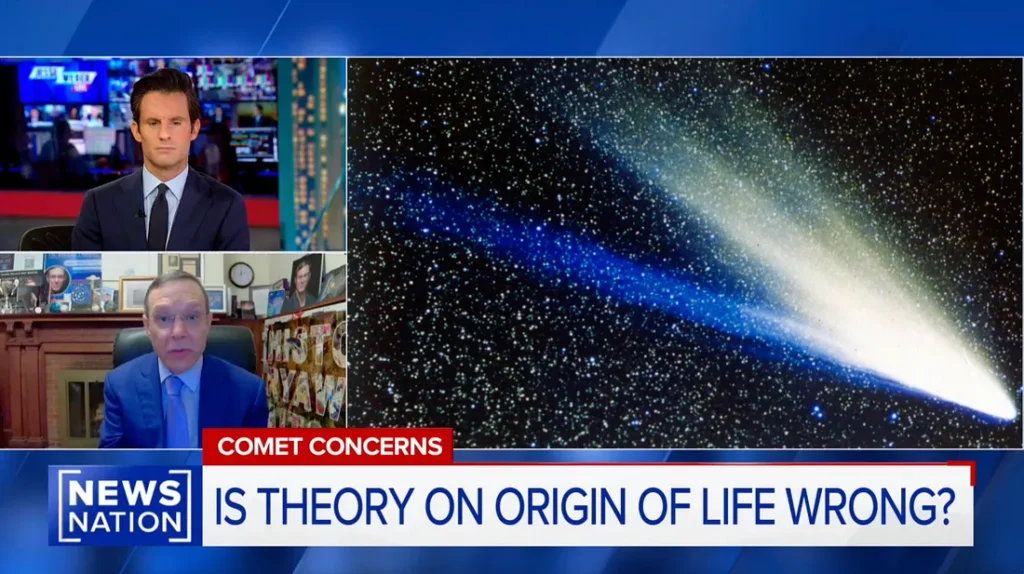
The benefits of a precious package can only be realized if an agent brings it to its destination. The wind acts as the agent delivering dandelion seeds to a fertile ground and allowing new dandelion flowers to blossom. For over a century, it has long been conjectured that comets (icebergs) or rocks (asteroids) delivered the building blocks of life to Earth. This week, a new Nature paper here argues that the rapid decline in Earth’s cometary impact bombardment at late times and the efficient destruction of fragile cometary organics at the high impact speed of comets diminish the prospects of a successful delivery of prebiotic feedstock molecules, like hydrogen cyanide (HCN), to Earth.
Below is the transcript of an interview that I had last night with Jesse Weber at NewsNation about this paper. Jesse’s questions are labeled with JW and my answers with AL. The full video clip is available here.
JW: What’s the origin of life on Earth? We thought we knew. Scientists for over a century believe that comets provided the seeds for life right here on Earth. The theory was that these comets were packed with the necessary carbon and nitrogen molecules to spark life on this planet but now there is a new study out of the University of Cambridge that is putting all of that into question. This study took a look at one main compound HCN which is composed of hydrogen carbon and nitrogen, and it suggests that the rate a comet travels and the angle of its impact on Earth would cause these molecules to vaporize. While the study says it’s not impossible, they say it would be statistically unlikely that HCN was delivered to Earth by comets. A comet would have to survive a fluke soft landing.
There would not be enough concentration of the molecules in water to create life.
So how exactly does this study impact our understanding about life on Earth? That’s why we got Avi Loeb, Harvard professor, astrophysicist, head of the UAP Advisory Council.
Good to see you, sir. So, what do you think? Is it very unlikely that comets are the source for life on Earth?
AL: Thanks for having me. The paper that came out last week considers, as you mentioned, just one molecule, hydrogen cyanide (HCN), which is considered to be an important critical precursor for the origin of life because it serves as a universal chemical building block for all the major components of living cells, like nucleic acids, proteins, lipids, and so forth. However, the authors find in the same paper that the delivery of hydrogen cyanide (HCN) to a planet like Mars is much more likely. The main reason that it’s destroyed during impacts on Earth is because most comets arrive at very high speed, given that Earth is closer to the Sun than Mars. And so, the molecule is destroyed in the cometary fireball that results from friction on air. But on Mars, HCN could have been preserved.
Obviously, if comets established life on Mars early enough, primitive forms of life like microbes could have been delivered to Earth through asteroids. We know that rocks rather than icebergs could survive entry through the Earth’s atmosphere if they originated on Mars.
We have some examples of rocks, like ALH84001 (as reported here) that were not heated above 40 degrees Celsius from origin on the Martian surface to delivery on Earth’s surface. If such rocks carried microbes in them that came from Mars, that could have triggered life on Earth.
JW: So, we’re Martians? We’re Martians, potentially?
AL: It’s quite possible. We don’t know that for a fact. We know that the first forms of life, the Last Universal Common Ancestor (LUCA), emerged about 4.2 billion years ago (as reported here). That is after Mars was able to cool to habitable conditions. Mars is a smaller object than Earth that provided the conditions for life earlier than Earth. We know that it had liquid water on the surface early on when LUCA showed up. So, it is quite possible that local life was triggered first over there.
JW: Is there any other explanation that, put aside an asteroid, put aside a comet, put aside that delivery mechanism, for the emergence of the building blocks of life here on Earth?
Is there another way that this could have happened?
AL: Of course, HCN could have formed out of the hydrogen, carbon and nitrogen that were available here on Earth. The authors of this paper considered comets that are thought to have delivered water to Earth. But the hydrogen cyanide molecule could potentially also exist in rocky asteroids that are not as fragile and could be delivered to Earth. I would not dismiss other channels of delivery.
The paper only shows that hydrogen cyanide has a hard time surviving when delivered in iceberg form through the atmosphere of Earth, because the comet gets vaporized and reaches very high temperatures as a result of the high impact speed.
JW: How does this impact our understanding of not only the history of our planet, but where we fit in the universe?
AL: This paper just rules out one delivery channel of one type of molecule through icebergs, but not necessarily through rocks. There could be molecules other than hydrogen cyanide that played an important role.
Incidentally, we know that hydrogen cyanide was shed by the interstellar object, 3I/ATLAS, which passed through the inner solar system last year. We also know that amino acids are very common in asteroids in the inner solar system, like Bennu and Ryugu, based on studies of their material in laboratories on Earth. So, it’s possible, for example, for the building blocks of life to have been available on rocks that survived the passage through the Earth’s atmosphere. Big asteroids only get heated on their surface, but not much in the core as they pass through the Earth’s atmosphere (as reported here).
JW: Is there a way to think about this, that the authors could be wrong? The perfect conditions could have existed at that one time for that comet to come through. I hear exactly what they’re saying in terms of it vaporizing and also the severity of the impact. But it is possible that there could have been the ideal conditions in one large comet for it to happen.
AL: Indeed. For example, the authors do the statistics based on their estimated impact rate.
And they find that early on in the solar system, there was a heavy bombardment of comets, but that was too early for life to develop on Earth. One needs just the perfect object that would move along at the Earth’s orbital velocity around the Sun so that it would not impact the Earth’s atmosphere at a high speed. Who knows, maybe one such object existed? These are statistical arguments.
It’s also possible that we are all Martians. That wouldn’t be so bad. It would mean that Elon Musk is trying to deliver human beings back to Mars. But in fact, there were tiny astronauts in the form of microbes that were the first to make the trip the other way around billions of years ago. This teaches us a sense of cosmic modesty that tasks that are far more impressive than what we are trying to accomplish with our technologies were already performed by nature, billions of years ago.
JW: You know what? A lot of people who are listening to this and probably thinking: “I always felt like I didn’t belong here. Why do I feel like this planet is not right? Now I get it. I like that theory. That is a theory I have not heard yet and I am going to be thinking about that.
Professor Avi Loeb, thank you so much for always taking the time. I know your time is precious and I appreciate it.
AL: Thanks for having me.
Authorized publication by Dr.Avi Loeb