Este artigo foi escrito originalmente em inglês.
 Ler em Português
All it takes is one event beyond a reasonable doubt to revolutionize our understanding of the Universe.
On January 7–15, 1610, Galileo Galilei observed through his telescope four sources of light, aligned in a straight line and orbiting Jupiter. These moons were later labeled Io, Europa, Ganymede and Calisto. The discovery shattered the Earth-centered model of the Universe. Similarly, a single high-resolution image of a non-human made interstellar spacecraft will shatter the notion that humans are at the top of the cosmic food chain.
Cosmic humility is in place because we do not even know the nature of 85% of the matter content of the Universe. Cosmologists label it `dark matter’ because for nearly a century it has been invisible to observations through telescopes. The existence of dark matter is inferred through its gravitational effect on the ordinary matter in the form of stars and gas.
Based on the dark matter distribution in low-mass galaxies on small spatial scales as well as the clustering of galaxies on large scales, cosmologists inferred that the dark matter particles must have had a small velocity dispersion when these structures formed. This is naturally accommodated by massive particles that decoupled early from the hot radiation that filled the Universe because of their weak interactions, and cooled to a low temperature by the time these structures condensed gravitationally. Over the past four decades, weakly-interacting massive particles, abbreviated as WIMPs, were the leading candidate for the nature of dark matter. Nevertheless, they evaded laboratory detectors designed to capture the signatures of rare events associated with the steady stream of WIMPs from the Milky-Way galaxy through Earth.
A new paper, posted here, reports about one event that could potentially signal the first detection of WIMP interaction with ordinary matter. A new analysis of data from the LUX-ZEPLIN (LZ) experiment has recorded a single particle interaction that cannot be explained in terms of known background signals. The result does not meet the statistical threshold required to claim a discovery, but is the most compelling hint of dark matter reported to date.
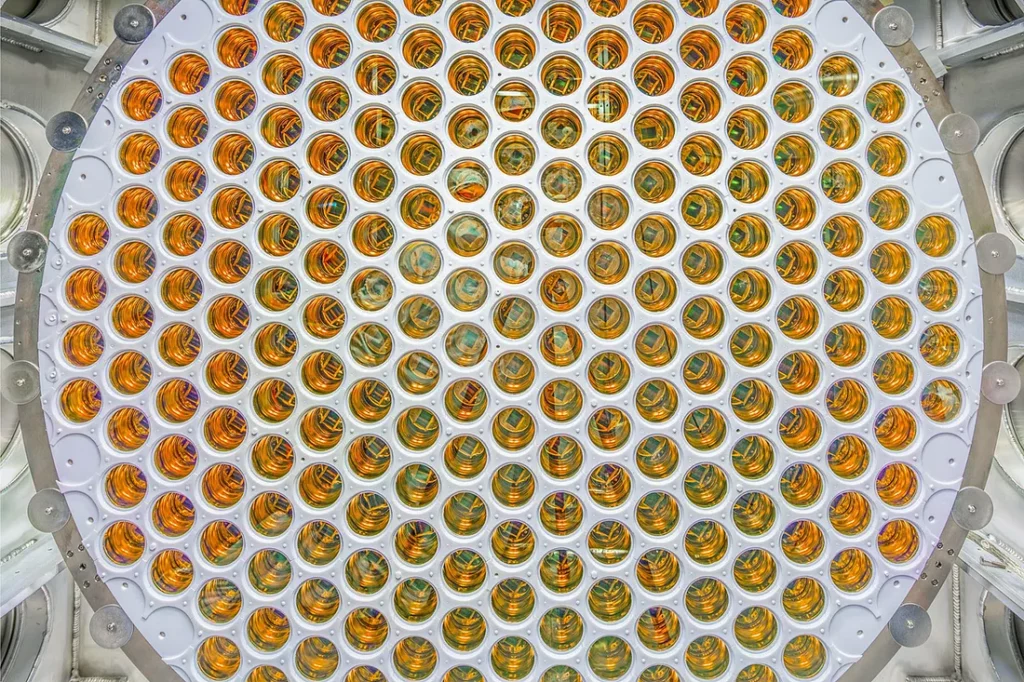
LZ uses an ultra-sensitive detector made of 7 tonnes of liquid xenon to detect scattering events of WIMPs on nuclei. It was formed in 2012 by combining the LUX and ZEPLIN groups, and includes a collaboration of 30 institutes in the U.S., UK, Portugal and South Korea. The detector is located at a depth of about 1.5 kilometers under the Sanford Underground Research Facility in South Dakota and is managed by the Department of Energy and the Lawrence Berkely National Lab. LZ searches for flashes of light from energy deposited in the detector. The experiment uses multiple methods to prevent or account for particle interactions caused by normal matter. This includes the mile of rock that shields the detector from cosmic-rays, a water tank and outer detectors that protect the central detector from background neutrons, and a suite of computational tools that disentangle particle interactions and reject dark matter mimics. It is one of three experiments in search for a direct detection of WIMPs with a mass above ten times the proton mass; the other two being the XENON and PANDAX-4T experiments.
The new LZ result is based on the analysis of 220 days of data collected between March 2023 and April 2024 from a 2.84 tonne-year exposure. The analysis searched for WIMP interactions that deposit a relatively large amount of energy in the detector, beyond expectations for the simplest model of WIMPs, while minimizing false positives.
LZ observed one event with characteristics consistent with a nuclear recoil energy of 248 ± 23 (statistical) ± 23 (systematic) keV (corresponding to about half the rest-mass energy of an electron), in a regime where the known background expectation is low. A profile likelihood ratio test finds tension with the background-only hypothesis at a global significance of 2.6-sigma when accounting for the look-elsewhere effect.
The LZ results have not reached “5-sigma” significance, the statistical threshold considered a discovery in physics, but only represent a 2.6 sigma, with a 0.5% chance that the event could be explained by known backgrounds. The standard threshold required to claim a discovery in particle physics is 5-sigma because the field has been burned repeatedly by 2 to 3-sigma “signals” that evaporated with more data.
If the anomalous event was caused by dark matter, the WIMP that generated it would likely have a mass of at least 200 times the proton mass. It would also suggest a specific type of interaction between WIMPs and ordinary matter that goes beyond the simplest model for WIMPs.
Future data could resolve the ambiguity about the significance of the new result. The XLZD Rare Event Observatory (https://xlzd.org/) is a planned, next-generation underground physics experiment designed to be the ultimate detector for dark matter and other incredibly rare particle interactions, at an estimated cost of about 700 million dollars. It would contain around ten times more liquid xenon than LZ and could detect hundreds of similar interactions over its lifetime, as necessary to determine whether unusual signals are evidence of new physics.
The new result is “worth watching closely” for future updates rather than “worth believing,” and its ultimate fate will most likely be determined not by more scrutiny of this same 220-day dataset, but by whether a next-generation, higher-exposure detector like XLZD sees the same signal recur with better statistics, or sees it vanish the way most such hints historically have.
Progress in science is driven by more data with better instruments, not by belief. Whereas belief is easily accessible and free of charge, acquiring new data requires hard work and major funding. This applies not only to dark matter searches, but also to the study of Unidentified Anomalous Phenomena and interstellar objects which so far received minimal funding.
Authorized publication by Dr.Avi Loeb