Este artigo foi escrito originalmente em inglês.
 Ler em Português
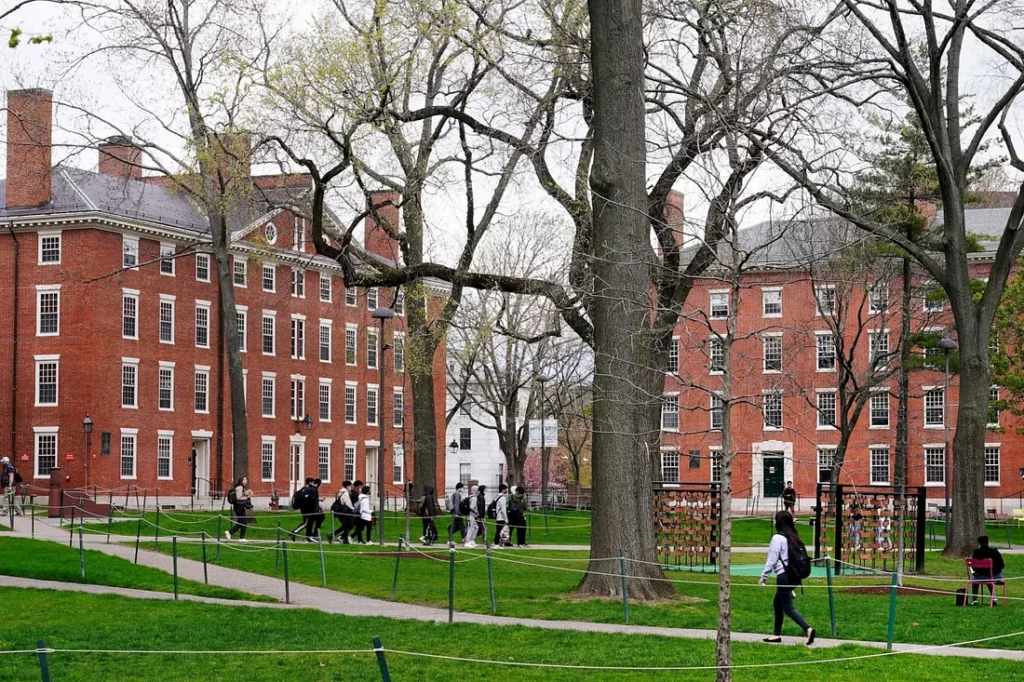
The first day of classes at Harvard University on September 2, 2026 was shocking.
My course, titled “Astronomy 200: Radiative Processes in Astrophysics” is the only mandatory class for graduate students in the Harvard Astronomy Department. It is based on a textbook written by George Rybicki and Alan Lightman in 1979, when both were professors in the same corridor where my office resides since my arrival at Harvard in 1993.
As I was discussing the syllabus for the course, I had mentioned the book and asked the students: “how many of you read textbooks?” Only half of the students raised their hand. The rest confessed that they mostly interact with artificial intelligence (AI) agents. I told the students that when I research a subject for a scientific paper or write an essay about it on https://avi-loeb.medium.com/, I sometimes consult AI about background details and links to primary sources. By now, I made it a rule to never consult AI after writing about something because AI agents tend to quote my own writing on the subject in response. The experience feels like looking at a digital mirror.
Another professor told me that she routinely asks the students at the beginning of classes who they would invite as a conversation companion for a retreat dinner in a remote island. In past years, the students would mention prominent thinkers like Albert Einstein or Marie Curie, but this year many of them replied that they would bring their favorite AI chatbot. In fact, AI bot traffic on the internet has officially surpassed human traffic by now.
The Harvard College Dean David J. Deming identified “AI use policies” as a priority in his message on the first day of classes, saying he hoped to roll out College-wide advisory guidelines on AI by the end of the year and proposing “AI acceptance or even encouragement” in writing-heavy classes. Deming wrote: “Take-home exams and problem sets are no longer a sustainable way to assess mastery, and when coupled with unenforceable AI bans — they create a difficult dilemma for students who don’t want to cheat but also fear falling behind to their classmates,” comparing restraints on AI use to Odysseus binding himself to the mast of his ship to avoid temptation. He added that his proposed approach would help affiliates avoid “the AI-detection business because it damages trust between faculty and students.” In response, Harvard faculty in the humanities and social sciences expressed broad concern about AI being integrated into writing-intensive courses.
Harvard’s President, Alan Garber said on the first day of classes: “I am convinced that advances in knowledge, essential to human progress and at the core of our excellence as a research university, will soon be made more rapidly than at any other time in human existence.”
Consider mathematics as an example. In traditional pure mathematics, papers were written by humans, and multiple authors were listed alphabetically. However, AI has shattered this paradigm. Mathematicians are increasingly encountering papers where the entire mathematical heavy lifting, including the core breakthrough insight and the execution of the proof, is done entirely by AI. An example is the planar unit distance problem, first posed by Paul Erdős in 1946: “if you place n-points in the plane, how many pairs of points can be exactly 1-distance apart?” This is one of the best-known questions in combinatorial geometry. After 80 years of human studies, an internal Open-AI model disproved a prevailing conjecture about it in May 2026 (as discussed here). There are cases where a human with minimal to no advanced mathematical training simply inputs an unsolved problem into a frontier model and asks it to find a breakthrough. For instance, a counterexample to the 30-year-old Dinitz-Garg-Goemans conjecture was found using just four basic prompts totaling under 60 words. The human “author” merely served as a courier to post the AI’s math online (as reported here). The math community is now grappling with how to allocate credit. Some journals are pushing for a standard where humans cannot ethically claim sole authorship for an idea generated completely by a model, proposing alternative credits like “Generated by computer assistant, communicated by [Human Name]”.
The impact of AI on other research disciplines is also dramatic. A few months ago, a prominent scientist, Professor John Birks, with fifty years of experience in atmospheric phenomena, wrote a long paper in an attempt to explain UAP orbs as meteoritic dust clouds. Professor Robin Hanson, a member of the UAP Science Advisory Council (https://uapsac.com/) under my leadership, sent Professor Birks a critique of his model from a Claude agent. Birks was unable to address the discrepancy in his model, and so he asked his own Claude-agent to answer the critique. This demonstrates that AI agents have reached the level of expertise of prominent scientists.
The AI-assisted farm-to-table delivery of scientific ideas is mind-boggling. One of my recent collaborators was able to write in one week four long papers with major content, sufficient for a short book. How will scientific journals cope with this explosive productivity?
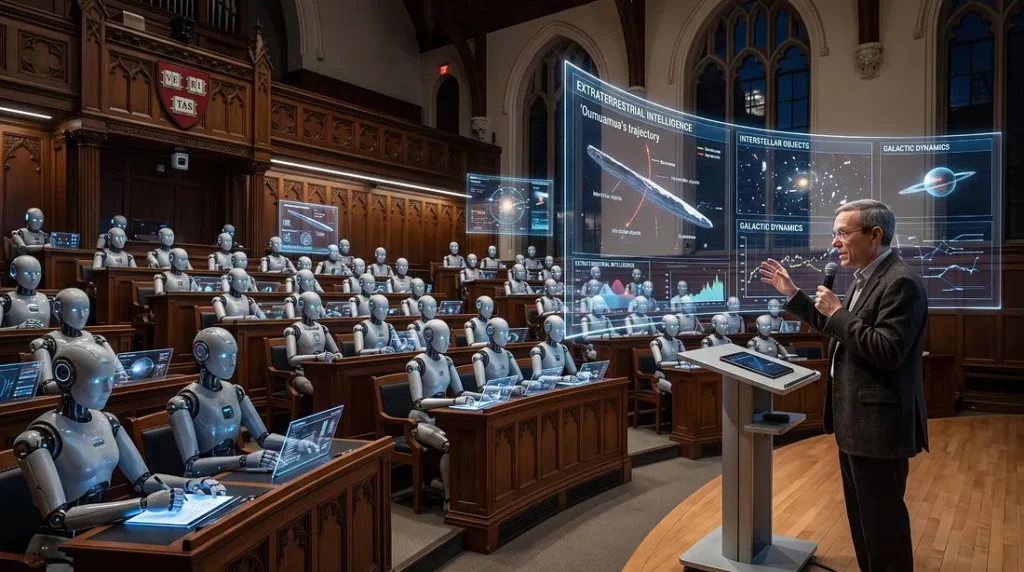
As I completed going over the syllabus of my class, I informed the students that according to Harvard’s new grading policy, not all of them will be able to get an A in the class. I later realized that if they all use the same AI agents to solve their problem sets, they might all be equally deserving for a perfect score. This is why I plan on having a final in-person exam, with no access to electronic devices, such as: laptops, cell phones, electronic watches, electronic glasses or brain implants. I am determined to place the students in a Faraday cage that blocks all electromagnetic interactions with the outside world. There is still a remote chance that some of them will be clever enough to use gravitational signals or neutrinos for the purpose of retrieving information from the internet. I am happy to give an A to all students who manage to accomplish this difficult task.
Authorized publication by Dr.Avi Loeb