Este artigo foi escrito originalmente em inglês.
 Ler em Português

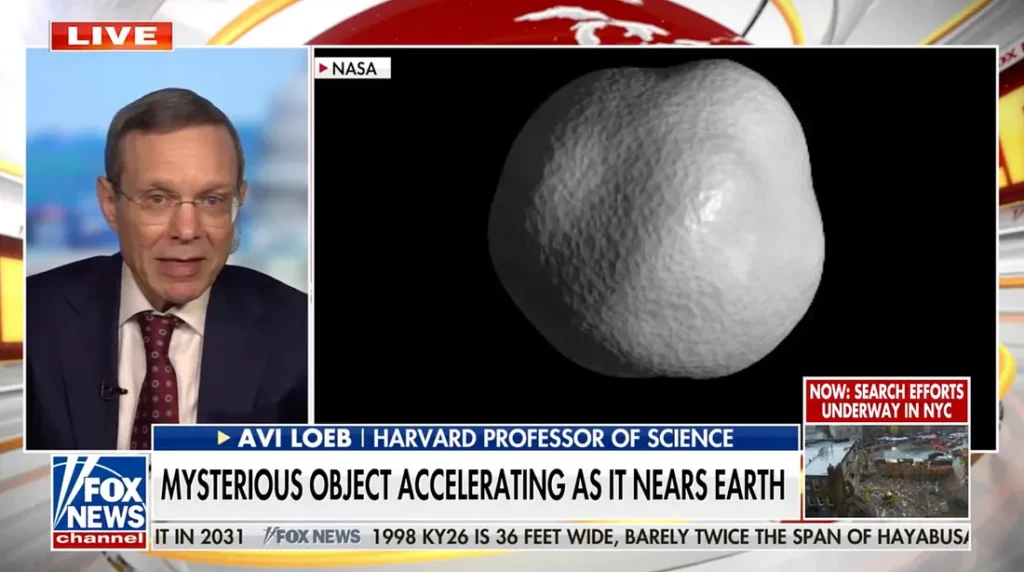
Yesterday, I tweeted here the headline: “Mysterious space object accelerates towards Earth as scientists debate”. This tweet about the object labeled 1998 KY26 received about a million views within a day. Below are more details on the context, in the form of the transcript of the second among two follow-up interviews (here and here) that I had with Fox Corporation. Questions are marked in boldface fonts below.
***
A strange object is moving through the solar system, and it’s leading to more questions than answers. Here, we have the man with the answers, Professor of Science at Harvard University, Avi Loeb joins us now to discuss this object. Great to have you with us, as always.
Let me jump into it. What’s your take on this object?
Thanks for having me. Comet experts argue that this object, labeled 1998 KY26, is a dark comet because a non-gravitational force appears to be pushing it away from the Sun, but we can’t see any signs of a cometary outgassing that would give it this push through the rocket effect on a regular comet. Therefore, they classify it as a dark comet.
What we noticed with my colleagues, Adam Hibberd and Adam Crawl, is that this object follows a similar trajectory to that of a lost Soviet spacecraft, Phobos 1, which was launched in 1988. Recent observations of 1998 KY26 indicate that it is very shiny reflecting roughly half of the sunlight that is impinging on it. It has a size of roughly 11 meters, comparable to that of the Phobos 1 spacecraft. We calculated that the reflection of sunlight from the solar panels of Phobos 1 can give this spacecraft the non-gravitational push and the light curve observed for 1998 KY26. And so, everything fits.
Nevertheless, comet experts in the mainstream of the astronomy community still believe that 1998 KY26 is an iceberg, and they want to visit it. As a result, the Japanese Space Agency JAXA will land the Hayabusa 2 spacecraft on this object in July 2031. Our alternative prediction is that when they land on it and study the properties of what they regard to be a mysterious iceberg that has invisible gas coming from it, they will find out instead the label: “Made in the U.S.S.R.” on it.
This is so fascinating. I just think about what it takes to land on this object in space, and then identify exactly all those details that you just mentioned. And if it was something that was discovered in 1998, why are we just now studying it?
1998 KY26 had been monitored over the years, but now there is this plan to visit it and learn more about it because it is classified as a mysterious dark comet.
The reason that the dark comet concept was invented is because of another object from outside the solar system called `Oumuamua, which was discovered in 2017. `Oumuamua also showed non gravitational acceleration without any outgassing of gas or dust around it. And so, the comet experts argued that `Oumuamua is a dark comet, and I argued that perhaps the sunlight is pushing it. In that case, `Oumuamua might be a technological object like Phobos 1, because `Oumuamua had to be very thin unlike any rock that we are familiar with.
To me, it would be a teaching moment if we visit 1998 KY26 and find that it is technological in origin, namely the Phobos 1 spacecraft launched by the Soviets, because it would show that maybe `Oumuamua was launched by an alien space agency from another star.
You are saying that the Sun’s energy could be propelling these objects.
Indeed, the sunlight can push technological objects which are relatively thin, just like a sailboat being pushed by the wind. Similarly to the air bouncing off a sail, sunlight reflecting off an object that is sufficiently thin or hollow ends up pushing it to measurable levels. In the case of Phobos 1, the solar panels were large and sufficiently thin to give it the observed push.
That’s fascinating. Fascinating. And then I think about this other thing that’s pretty fascinating. You were also tapped by the White House to lead the UAP Science Advisory Council, where UAP means Unidentified Anomalous Phenomena. A few days ago, you also shared plans to develop a system of specifically designed telescopes. Please tell us a little bit about that.
Yes, in fact a couple of days ago, I visited the Pentagon to discuss this new observatory concept. In the seven tranches of released files by the Presidential Unsealing and Reporting System for UAP Encounters, there are videos of unidentified objects. Some of them look like orbs, namely glowing balls of light that do not resemble drones or other technological objects manufactured by humans. A couple of months ago, I came up here with the idea of a new observatory concept, which includes a radar system monitoring the sky for these orbs. Once a UAP of interest is spotted, a large telescope, roughly a meter in size, is steered in the direction of the UAP and takes a high-resolution image of it. A meter-scale telescope can resolve a green pea out to a distance to a few kilometers. It can resolve passengers through the windows of an airplane. Such a high-resolution image will give us a lot of new information about UAP. But in addition, we plan to have a spectrograph that will take a spectrum of the UAP, allowing us to infer its composition. Within a couple of months after I imagined this observatory concept, I received a donation of the $1.5M needed to fund it. We are planning to put the first prototype in the old residence of Carl Sagan in Ithaca, New York, in celebration of Sagan’s legacy.
My main goal is to help the Pentagon and the intelligence community fulfill their national security missions. With the new data, we will know if we are dealing with some black project from an adversarial nation that is spying on the US. If instead some UAP represent alien technology from out of this world, finding them would be the biggest discovery ever made by humanity.
This is the most fascinating conversation that I’ve had in a while. Okay, this is a little off script, but I’m sure you’ve seen it. Recently, there was a jellyfish-like flying object in Alaska. Have you seen that, and what are your thoughts?
Yes, in fact, there were jellyfish reports already in the videos released by the Pentagon. By the way, there were about 3 billion views of these videos over the past 5 months, indicating a huge public interest in this subject. My tweet on 1998 KY26 yesterday here received a million views within one day! Clearly, there is a huge audience for unusual space objects, and the jellyfish objects were also observed in the Middle East and in other locations, where the military monitors the sky for national security purposes. Every now and then military personnel see something really unusual, and the type of objects that were reported are either jellyfish, orbs, or triangles, and all of these look strange. I spoke with people at the Pentagon and asked them: `Why don’t you assume that these are all human made technologies?’, and they replied: “Because the data is not consistent with what we know.’ They don’t have sufficient data to inform them that it’s alien technology, not human made. So, the interpretation is still open. We need better data and that’s what I’m aiming to get in partnership with them.
This is such a fascinating topic of conversation. The fact that the tweet and the videos have had so many views shows where the public’s interest is.
Well, this has been such an amazing conversation. It’s great to have you back on the show, Professor of Science at Harvard University, Avi Loeb. Thank you for your time this morning.
Thanks for having me. When we have better answers, I’ll be glad to speak with you again.
Addendum: the scientific context
Last week, a new paper published here in the prestigious scientific journal Icarus, reported that all locations on the surface or in the interior of 1998 KY26 have orbit-averaged temperatures significantly above the sublimation point of volatiles in vacuum. These results indicate that the water outgassing rate on 1998 KY26 would be too high to maintain buried ice. Even though the results are consistent with the interpretation that 1998 KY26 is the lost soviet spacecraft Phobos 1, the authors of this paper ignored this possibility and chose not to cite the two papers that I co-authored on this subject with Adam Hibberd and Adam Crowl, here and here. In reference to the aggressive pushback that our two papers received from comet experts and the lack of references to our work in this new paper, I wrote to my co-authors: “Comet experts and referees can play games and suppress a fair assessment of the existing data for now. But after the Hayabusa 2 spacecraft of the Japanese Space Agency (JAXA) lands on 1998 KY26 in July 2031, these dogmatists will eventually have to admit the truth. As the Vatican learned from the Galileo affair, knowing the truth cannot be avoided, only delayed.”
Our first paper here suggested the hypothesis that 1998 KY26 may be a relic of the Russian probe Phobos 1, which suffered a failure 2 months after the launch in July 1988, due to upload of a faulty command by matching the trajectories of Phobos 1 and 1998 KY26. Our second paper here analyzed recent radar and optical observation of 1998 KY26 which indicated an unusually rapid spin-rate with a period of 5.35 minutes (much faster than an icy rubble pile can sustain), a diameter of 11 ± 2 meters, and a shiny surface which reflects 52% of the sunlight. We explained the observed level and direction of the non-gravitational acceleration of 1998 KY26 with no detectable shedding of gas or dust, as a result of the reflection of sunlight by the solar panels of Phobos 1. This reflection also explains reasonably well the inferred shape and the observed light curve of 1998 KY26.
The insistence of comet experts on the hypothesis that 1998 KY26 is a dark comet and their refusal to acknowledge the competing hypothesis that it is a technological object rather than an iceberg underline how dogmatic the scientific mainstream has become.
Dark comets are a proposed class of curious hybrids between comets and asteroids. These objects show significant non-gravitational accelerations, yet they exhibit absolutely no sign of cometary outgassing in the form of a coma or tail. The first recognized interstellar object, 1I/`Oumuamua, showed these features and was suggested to be a `dark comet’ in a recent mainstream publication here. However, based on its inferred flat shape (published here) and non-gravitational acceleration (published here), I argued 8 years ago here that 1I/`Oumuamua might be pushed by sunlight and is technological in origin. The dark comet categorization of 1I/`Oumuamua and similar solar system objects was the mainstream response to my nontraditional suggestion.
The stakes for 1I/`Oumuamua being technological in origin are much higher than for 1998 KY26, because its high speed cannot be of human origin. Realizing in July 2031 that 1998 KY26 is technological rather than a `dark comet’ would suggest that maybe comet experts should not be trusted and 1I/`Oumuamua is the first encounter of astronomers with alien technology. As I said all along, Elon Musk is probably not the most accomplished space entrepreneur over the past 13.8 billion years. There are billions of homes similar to Earth in our cosmic street of the Milky-Way galaxy and it is unreasonable to suggest that there are no space agencies beyond Earth.
Authorized publication by Dr.Avi Loeb