 Este artigo foi escrito originalmente em inglês.
 Ler em Português
Below is a transcript of the latest interview I had last night with Natasha Zouves on NewsNation, which is also available in video format here. Natasha’s comments and questions are marked with NZ and my answers are marked with AL.
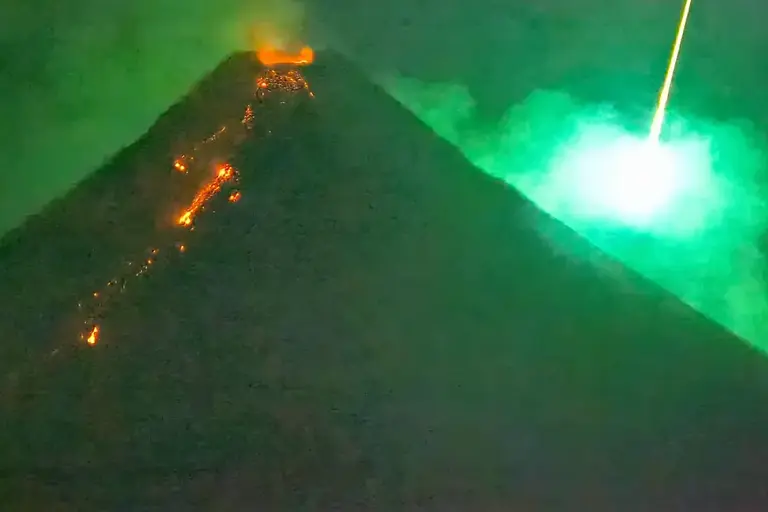
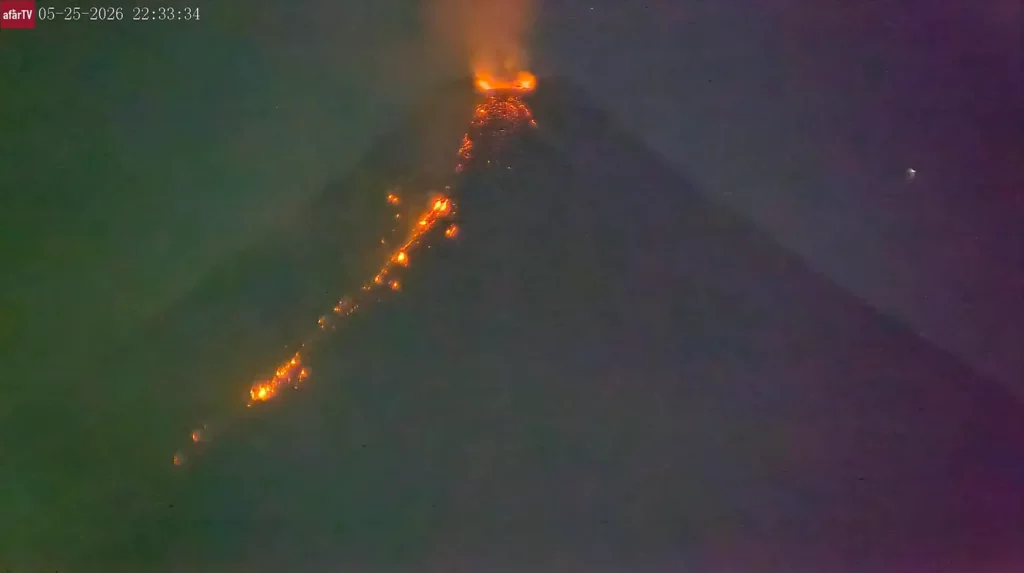
NZ: An incredible viral video shows a meteor crash near an erupting volcano. Take a look at the clip from afarTV on YouTube, available here. You can see the meteor coming down. But what comes next might be much more interesting. Do you see this? This mysterious orb of light seen rising up from the landing site? This volcano is in the Philippines, and this clip is raising so many questions tonight.
Let’s discuss with Professor Avi Loeb, renowned theoretical physicist, Harvard Professor, head of the Galileo Project. Professor Loeb, always a joy to see. So good to see you again. I want to bring up the footage again, as you can walk us through what we’re seeing here.
What do you see in the video and what goes through your mind here?
AL: Thank you so much for having me, Natasha. We see a strike of a meteor, not at the volcano but behind it. The white light source rising up to the right of the volcano is most likely the glint from a satellite that reflects sunlight. There are more than 10,000 communication satellites moving around the Earth, so it’s not very unlikely to see such a coincidence.
NZ: So, you think that these are completely unrelated, and this rising light is not originating from the meteorite. It is literally an unrelated satellite that is reflecting sunlight.
AL: Right. The rising white light is moving along a straight line as expected for a satellite.
NZ: So, in your opinion, this is not a UFO.
AL: No. What people label as UFOs is obviously a mixed bag. Most of the time, these are phenomena that are related to human-made objects or natural phenomena as we are discussing. In this case, we have a combination: the meteor is a natural phenomenon, and the satellite is human made.
When considering UFOs, the challenge is to characterize the object enough to rule out the possibility that it’s human made or natural.
NZ: So, it’s just a coincidence that the rising white light seems to be following almost that exact same reverse path.
AL: Right. As of now, satellites pose a major issue for astronomical observations, because they shine light in the night sky. There are lots of streaks that are observed in exposures from astronomical observatories. That’s a major issue, because astronomers used to go away from city lights, but now there are city lights in the sky.
NZ: Very interesting and well put.
I want to get your take on this as well. It’s now being reported that White House Deputy Chief of Staff, Stephen Miller, discussed amnesty for UAP whistleblowers with Congressman Eric Burleson, who was proposing a 60-day window for those with information to come forward. I assume that you think this is important.
AL: It’s very important, because so far, in the two batches that were released of UFO videos, images, and documents, the data was not good enough for us to identify any object of extraterrestrial origin. Presumably, there would be much more information available from people who work within the government, that have knowledge of higher quality data. In particular, whether there are any materials from crash sites, as David Grusch suggested in his testimony in Congress. In fact, David Grusch will be involved in a public event, announced here, that will take place on Tuesday, June 9 at 1PM ET, where he and Representatives Burlison, Moskowitz, Luna, and Burchett, will discuss this topic.
The fundamental question is whether there is classified information or materials that were delegated to corporations such as Lockhead Martin or MITRE, that are of much higher significance. Giving amnesty to whistleblowers would be fundamental in allowing this information to get to the public.
NZ: Yes, absolutely. I’ll be speaking with Congressman Burchett tomorrow, so we’ll be discussing that as well.
Let me ask you one more thing in the time we have left. There is also this theory going around that the CIA is monitoring certain ancestry or genetic type test websites for genetic markers that could help identify potential aliens living among us. What are your thoughts on this? Is this a real possibility or just another wild theory?
AL: It’s possible that some people are speculating, but I think it’s extremely unlikely extraterrestrial biological beings share our DNA, because our DNA is a relatively recent phenomenon here on Earth. The human species existed only for the past few million years. Before that, terrestrial DNA looked different among other species on Earth.
All forms of life on Earth have a DNA with one chirality, a specific orientation of their double-helix molecular structure. Terrestrial DNA is right-handed. If aliens come here even with the same DNA building blocks, it’s not clear whether their double helix would be organized in a right-handed or left-handed configuration. Obviously, we should not shake their hands, let alone have babies with them. Our body is not protected from the diseases of left-handed DNA. The encounter would pose a health risk for us.
All in all, I would argue it’s very unlikely to encounter DNA from another star that matches specific life forms on Earth.
NZ: We shot a couple of full podcast episodes together, Professor Loeb, and that’s one of the things I remember. If you ever meet an alien, never shake its hand. That’s what you told me. I’m keeping that top of mind. Professor Avi Loeb, always a joy. Thank you so much.
AL: Thanks for having me.
Two follow-up notes after the interview:
First, the Mayon volcano in the Philippines is at an altitude of 2.5 kilometers. This makes a satellite appear brighter than at sea level, because there is less atmosphere to block its light. The clouds are below the peak of the volcano, not above it.
Second, the rising light appeared about a fifth of a minute after the meteor exploded. There are about 15,000 active satellites and they orbit the Earth more than 10 times each day. Since there are 1,440 minutes in a day, about 100 of them should appear across the sky every minute. Seeing one of them a fifth of a minute after the meteor event is not unlikely.