Este artigo foi escrito originalmente em inglês.
 Ler em Português
To paraphrase Mark Twain, I say that there are three types of lies from small to big: “There are lies, damn lies, and internet lies.”
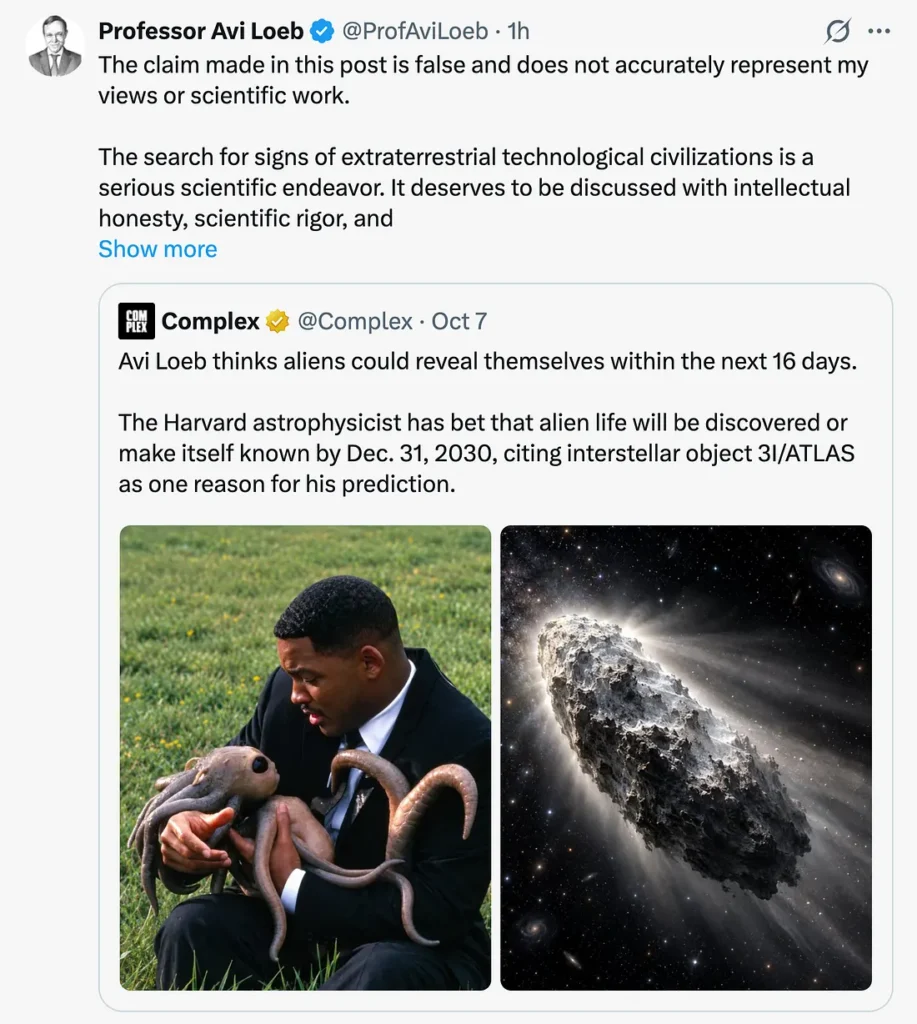
Today, an X account @Complex with 2.6 million followers lied by posting here: “Avi Loeb thinks aliens could reveal themselves within the next 16 days.” I never stated that. It is clear that the lie was invented to attract attention because it instantly received over 100k views, ten times more than the other clickbait posts on this account.
As I explained in response here:
“The claim made in this post is false and does not accurately represent my views or scientific work.
The search for signs of extraterrestrial technological civilizations is a serious scientific endeavor. It deserves to be discussed with intellectual honesty, scientific rigor, and respect for the evidence. I have seen and heard from many people who are understandably frustrated when my words are taken out of context, distorted, or used to promote misinformation. I understand their frustration and share their concern.
My effort to popularize the scientific search for non-human intelligence and extraterrestrial technology requires that I communicate directly with the public. Going forward, this will also include publicly correcting those who misuse my name, misrepresent my statements, or attribute claims to me that I have never made. Science advances through evidence, not misinformation.
I welcome criticism and scientific debate, but they must be based on what I actually say and do. Also, I want to thank the many people who continue to support my work and the scientific search for extraterrestrial technology. Your encouragement, curiosity, and positivity provide me with tremendous motivation to continue this important effort. The universe is vast, and there is much left for us to discover.
Let us focus on finding the truth.”
Other misinformation is nasty. A YouTuber has been spreading antisemitic narratives about me. This is particularly hurtful because my father’s family had its roots in Germany for seven centuries. My grandfather, Albert Loeb — after whom I am named, survived the famous battle of Verdun against France and was awarded a medal for it when Hitler came to power. He later threw the medal away and decided to immigrate out of Germany to what became Israel. This followed a gathering in his town Netze, where a member of the Nazi party argued that the Jews are using up the resources of Germany for their own benefit. My grandfather stood up and asked the speaker: “How dare you say this when you personally dodged the draft in the first World War as a communist while I was on the German front?” The speaker replied: “We all know about your patriotic contributions, Mr. Loeb; I was talking about the other Jews.” At that point my grandfather decided to leave Germany, while other branches of the family stayed, believing that they could leave with the last train. Unfortunately, that train led elsewhere and all 65 of his family members were killed in the holocaust. Albert eventually settled in a small village, called Beit Hanan, around 1936. We visited Netze with my father, David Loeb, three decades ago when a new street was named after my grandfather, the “Albert Loeb-weg”, as the family was highly regarded and included the only Jews in town. This street can be found on Google Maps here.
The YouTuber who spreads antisemitic narratives against me will not be remembered well in history. I have the survivor DNA of my grandfather.
What is the path forward?
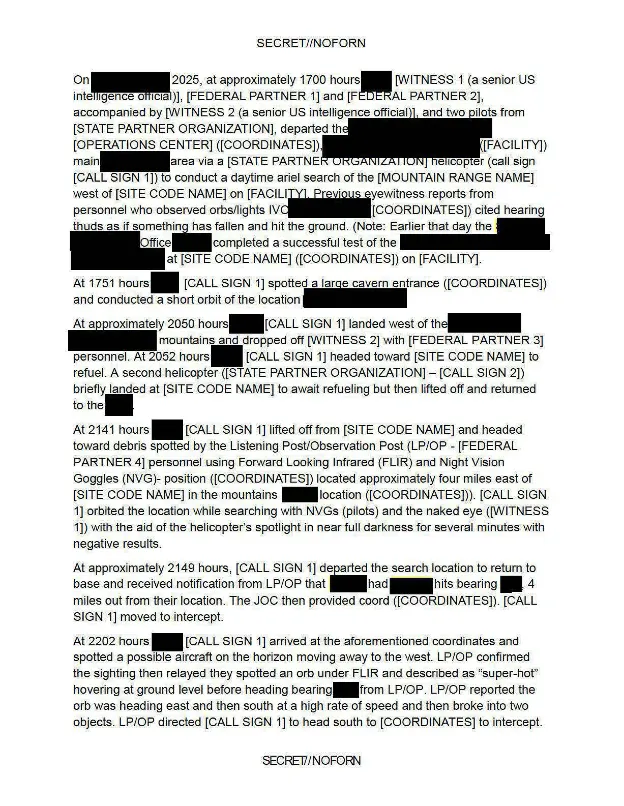
Over the past 5 months, the Pentagon released 6 tranches of UAP data. Most puzzling are recurring orbs with properties that cannot be mimicked by known drones, missiles or aircraft. At sensitive government locations, some of these orbs have reportedly approached to within roughly 10 feet of senior intelligence officials and have outpaced helicopters and jets. These recurring encounters offer a massively unique opportunity to move beyond distant or ambiguous observations and capture high-quality, unclassified scientific data on a truly anomalous phenomenon.
Shortly after the first PURSUE release, I was tasked by the Office of the Director of National Intelligence (ODNI) to establish and lead a UAP Science Advisory Council in service of the White House, the Pentagon, the Intelligence Community and the FBI (as recently reported in POLITICO and the New-York Times). I am currently leading a 20-member council as well as the Galileo Project — which constructed 3 UAP observatories and recently demonstrated triangulation results here. The 4th Galileo Observatory, to be placed in Carl Sagan old residence in Ithaca, NY, is based on my novel design, described here, which combines a radar system for finding UAP orbs in the sky and steering a large telescope to obtain high resolution images and spectroscopy of these orbs.
We are currently in the process of establishing a scientific partnership that will enable the government to guide scientists like myself in bringing new state-of-the-art scientific instruments and sensors to locations where recurring UAP sightings are reported. The goal is not merely to document their presence, but to collect measurements capable of shedding light on the propulsion, energy sources and materials associated with these orbs and craft. This represents a rare scientific opportunity: recurring phenomena at known sensitive locations can be studied prospectively with purpose-built instrumentation, potentially yielding the first high-quality, unclassified dataset capable of testing what these objects are and how they operate.
Such measurements could provide new insight into their apparent propulsion, energy and material properties. If high-quality measurements confirm capabilities beyond known technologies, understanding the physical principles that enable them could open new areas of scientific inquiry with implications far beyond UAP research. The resulting data could inform research into advanced energy generation, potentially including fusion; room-temperature superconductivity; and novel materials, including the elemental, mineralogical and structural properties required to produce objects capable of the reported performance. The opportunity is therefore not merely to identify UAP, but potentially to discover new physics, materials or engineering principles through the scientific study of phenomena already being repeatedly observed.
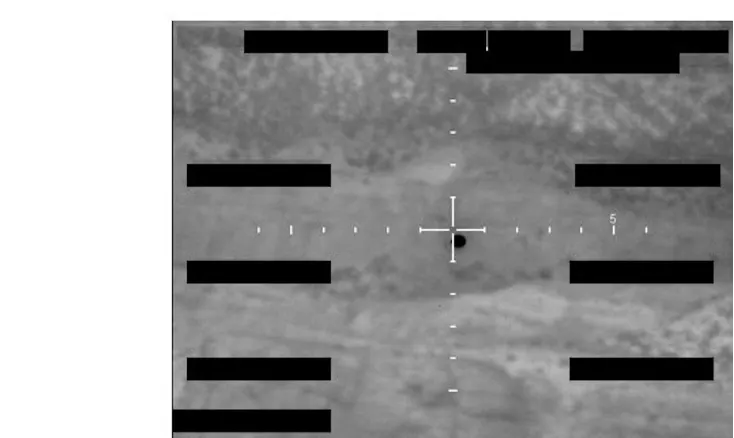
Over the past week I posted two scientific papers that illustrate how science is done in the context of the search for alien visitation of Earth. One of the papers from the Galileo Project, posted here, demonstrates how distances to UAP can be measured through triangulation by observing the UAP from different directions. Another paper from the UAP Science Advisory Council, posted here, shows that six mysterious dots in a UAP video declassified in the Presidential Unsealing and Reporting System for UAP Encounters (PURSUE) are a flock of birds rather than alien technology.
The best is yet to come.
Below is a short Q&A that I exchanged today with Springfield College Nugegoda in Sri Lanka:
1. Looking back, what has been one of the most important lessons from
your journey in science?
Maintain your childhood curiosity. The truth is not always followed by the herd.
2. What is one challenge or failure that taught you something valuable?
Sometimes evidence goes against our expectations. Ignoring it leads to an ultimate failure. Paying attention to it allows us to learn that we were wrong.
3. What advice would you give to students who are fascinated by big
scientific questions but are afraid of being wrong?
Follow these questions by yourself and go public only after you verify beyond any doubt that your analysis is valid.
4. How do you decide when an unconventional scientific idea deserves
serious investigation rather than dismissal?
If the idea is not ruled out by known facts and leads to testable predictions, it is worth pursuing because it offers an opportunity to learn something new.