Este artigo foi escrito originalmente em inglês.
 Ler em Português
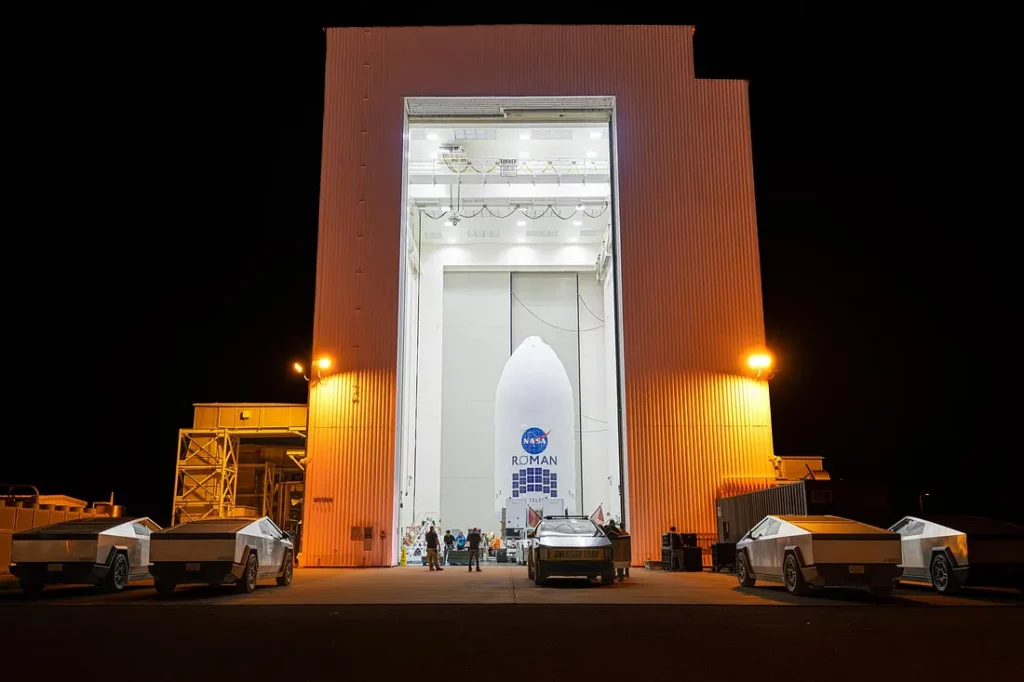
This morning, the $4.3 billion Nancy Grace Roman Space Telescope is about to be launched by NASA to a Sun-Earth L_2 orbit. Roman’s 2.4-meter primary mirror was donated by the National Reconnaissance Office, and has a wide field of view of 0.28-square degrees that is 100 times larger than that of the Hubble Space Telescope. Because of its massive 300-megapixel infrared camera (so-called, the Wide Field Instrument) and wide view, Roman can collect as much data in one month as Hubble could manage in 100 years. Equipped with a coronograph and a spectrometer, Roman’s primary scientific missions (as reviewed here) include a search for extra-solar planets using gravitational microlensing (a method that I pioneered with Andy Gould in a paper published in 1992 here) or the coronograph to block the light from a host star, along with probing the cosmic expansion history and growth of cosmic structure, with the end goal of measuring the effects of dark energy, the consistency of General Relativity, and the curvature of spacetime.
Roman’s optical design is close to ideal for the discovery of interstellar objects as they enter the Solar System at high speed. Roman can cover enormous swaths of sky per exposure while still resolving faint, small objects. Its infrared sensitivity is useful for characterizing composition and detecting cool objects that optical-only surveys, like the ground-based ATLAS survey that found 3I/ATLAS, might miss.
There are related discussions about Roman’s potential for planetary defense and moving-object detection, as reviewed here. Astronomers are actively developing detection pipelines (like the “RAPID”/RuBRand machine-learning classifier work) specifically to sort genuine moving source detections from noise in Roman’s data stream.
However, the standard pipeline image processing scheme that the Roman mission is planning to implement for the majority of its survey data will preferentially ignore all moving objects during the process of cosmic-ray rejection. Roman’s core survey strategy, built for its primary dark-energy and exoplanet-microlensing missions, processes images assuming that anything varying between exposures in an unexpected way is noise, like cosmic-ray hits, rather than a real moving object. A fast-moving interstellar object streaking across the field between exposures would, under default processing, risk being algorithmically discarded. Whether Roman actually discovers interstellar objects is therefore a software and pipeline question. The telescope is fully capable of making such discoveries, but realizing that capability depends on non-default processing choices being funded, developed, and deployed.
The Vera Rubin Observatory’s Legacy Survey of Space and Time (LSST) represents a more natural discovery machine for interstellar objects, as its entire survey strategy is built around repeated, rapid-cadence imaging of the visible sky designed to detect moving objects, the opposite strategy from Roman’s deep, pointed surveys.
Given NASA’s interest in the characterization and threat assessment of near-Earth Objects (NEOs) for planetary defense, Roman might be used to measure the physical properties, compositions, and orbital trajectories of NEOs as potential hazards to Earth. Roman’s planetary defense capabilities complement the Rubin Observatory and the upcoming space-based NEO Surveyor, to be launched by NASA in 2027. Rubin, observing in visible light, is expected to discover more than 100,000 NEOs. The NEO Surveyor, observing in the mid-infrared where NEO thermal emission peaks, is expected to detect 200,000–300,000 NEOs, some as small as 20 meters in diameter. Astronomers from the Space Telescope Science Institute propose to develop the pipeline infrastructure required to extract information from moving target streaks in Roman data, thus improving measurements of NEO orbits down to 20-meters in diameter by 2–3 orders of magnitude in conjunction with NEO Surveyor.
NASA’s Planetary Defense Coordination Office is focused on asteroids with a diameter larger than 140 meters, about the length of a football field or 1I/Oumuamua. There should be of order 25,000 such NEOs, with half of them yet to be found. NEO Surveyor could find 90% of them. However, there should also be of order 230,000 NEOs with a diameter larger than 50 meters, of which less than 10% are known. An impact on Earth by any of them would release the equivalent of 8 megatons of TNT, about 540 times the energy output of the Hiroshima atomic bomb. Killer asteroids could potentially be deflected by ramming a spacecraft into them (as demonstrated by NASA’s mission DART) or vaporized by a powerful laser or a nuclear weapon.
Once the NEO Surveyor identifies objects that have a chance of impacting Earth, Roman could be used to improve the orbital precision by several orders of magnitude. Since Roman is separated in space from both the NEO Surveyor and the Rubin observatory, the three observatories with their different viewing angles can triangulate and precisely determine NEO orbits.
Roman’s infrared sensitivity can be used to infer the size and composition of NEOs, whether they are rocks, a puffy and watery carbon-rich icebergs, or a metallic object. This will allow us to differentiate between natural stones or icebergs and technological probes.
In the process of searching for NEOs, the supplemental pipeline infrastructure of Roman might also discover interstellar objects. Whether any one of them proves to be a metallic package sent to our mailbox by an alien civilization remains to be seen.