Este artigo foi escrito originalmente em inglês.
 Ler em Português
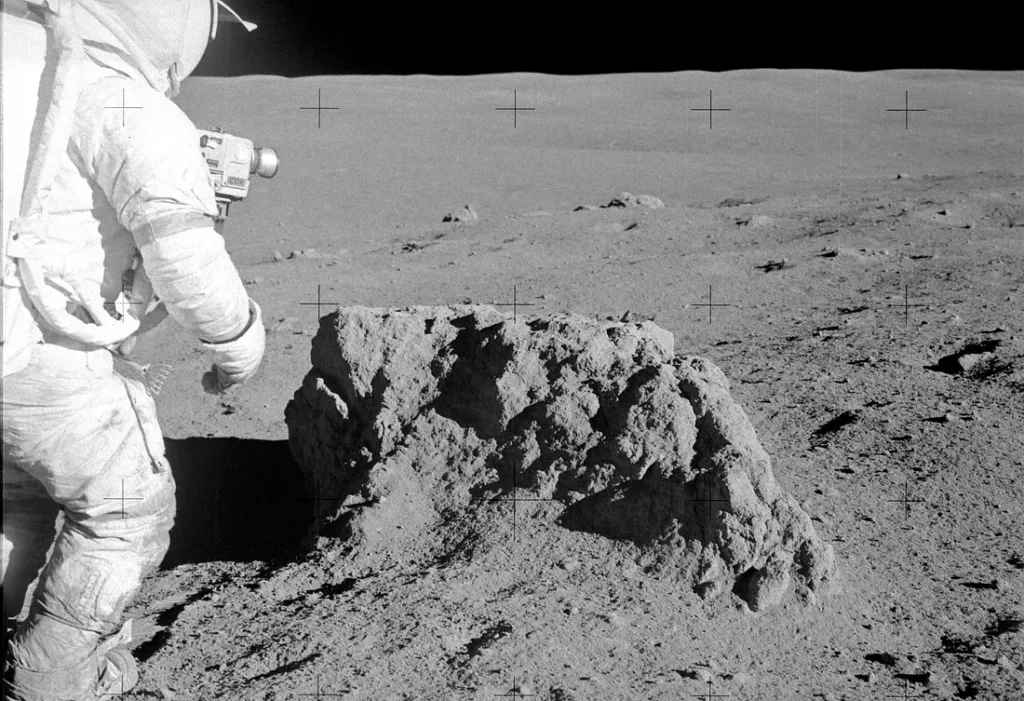
A detailed preprint, posted recently here, suggests a new path in the search for technological signatures of extraterrestrial civilizations. The idea is to analyze a cubic meter of lunar regolith and look for sub-micron dust particles that might be relics from long gone technological structures of past civilizations in the Milky-Way galaxy. Such particles may survive over billions of years in their journey through interstellar space and eventually land on the lunar surface.
The traditional search for electromagnetic signals from extraterrestrial civilizations requires contemporaneous transmissions, akin to waiting for a phone call. However, as I had been arguing after the discovery of the anomalous interstellar object 1I/’Oumuamua nine years ago, material relics accumulate over time even if their senders are long extinct. The Moon has no geological activity and may collect such relics on its surface like a museum with a historic exhibition spanning 4.5 billion years, the last third of cosmic history. For that reason, I often referred to the Moon as an important platform for the frontier of interstellar archaeology, as reviewed here.
The new preprint analyzes the transport and survival of micron-scale grains through the interstellar medium, including gas drag and sputtering. It shows that refractory particles with characteristic radii of order 0.3 microns could survive a journey of up to a billion years. A fraction of these grains can penetrate through the solar radiation and solar wind and survive impact on the Moon. Capping the abundance of such tiny particles in the lunar regolith was proposed as a way to set an upper limit on the cumulative material output of technological civilizations. In particular, the authors show that not detecting any grains of technological origin in a cubic meter of lunar regolith excludes scenarios in which Solar-type stars disperse more than 9% of the Earth mass in long-lived particulate debris over the history of the Milky-Way.
A landmark 2020 study published in Nature magazine (here) calculated the anthropogenic mass, namely the total mass of all inanimate, solid objects currently in use by humanity, such as operational buildings, paved roads, bridges, and active machinery. By now, this mass exceeds all living biomass and is approximately 1.1 trillion metric tons.
Let us imagine an optimistic scenario by which humanity will disperse a similar amount of anthropogenic mass to interstellar space. This is not an easy feat, as it requires propelling this material out at more than the escape speed from the solar system, corresponding to much more kinetic energy per unit mass than chemical propellants deliver. The production of interstellar probes like Voyager 1 & 2, Pioneer 10 & 11 and New Horizons, required a large fuel-to-payload mass ratio and a carefully tailored trajectory with a gravitational boost that benefited from the motion of Earth around the Sun. Relying on asteroids to destroy technological infrastructure on the surface of Earth — left over from a long-gone humanity, and launch it to space upon impact, will mostly raise dust that is trapped gravitationally to the solar system.
Let us supplement this optimistic hypothesis by imagining that every Sun-like star disperses a similar amount of technological dust to interstellar space and that all of this debris will survive. In this triple-optimistic model, the total accumulated mass per unit volume of technological dust is a few trillion times smaller than that of interstellar dust. This means that one would need to sift through trillions of grains before finding one that is technological in origin.
In fact, the numbers are even more daunting because the Moon is exposed to a much larger population of dust particles that originate in the Solar System itself. We observe such particles in Zodiacal dust. These interplanetary dust particles reside in a vast, pancake-shaped cloud that populates the solar system. Straddling the ecliptic plane of the Earth’s orbit around the Sun, this dust scatters sunlight to create a faint glow visible from Earth, known as the zodiacal light. Because of gravity, collisions, and the solar radiation drag (through the so-called Poynting–Robertson effect), the zodiacal dust is constantly spiraling inward toward the Sun. This means the cloud is constantly depleting and must be continuously replenished. It is sourced by Jupiter-Family comets and asteroid collisions with less than 1% of it originating from interstellar space. On top of that, the lunar surface was shattered into dust by numerous asteroid impacts throughout its history, making the discovery of interstellar particles as challenging as finding a tiny needle in a giant haystack.
So far, about 181 metric tons of technological material from Earth has been delivered to the Moon by space missions over the last half century. This includes crashed orbiters, landing gear, tools, and waste containers. The Moon collects roughly 10,000 metric tons of natural dust per year, implying that 1 million metric tons of natural dust have settled on the Moon over the last century. Despite the proximity of our technological civilization to the Moon, only one part in 5,000 of the mass that landed on the lunar surface during our modern technological age over the past century was human made. The chance of technological dust arriving at random from the vast scale of the Milky Way is much smaller and would be extremely difficult to separate from natural or human sources.
Obviously, the near-Earth abundance of functioning technological gadgets could be enhanced dramatically as a result of deliberate targeting of the habitable zone of the inner Solar System. Interstellar objects of the hundreds of meters size of 1I/`Oumuamua, 2I/Borisov or 3I/ATLAS, could potentially release small technological probes that navigate towards Earth and the Moon. For the same reason that bees are clustered around flowers, we might find alien tech concentrated around Earth with an abundance far greater than in interstellar space. This is why I am excited to chair the UAP Science Advisory Council (https://uapsac.com/) for the U.S. government.
Authorized publication by Dr.Avi Loeb