Este artigo foi escrito originalmente em inglês.
 Ler em Português
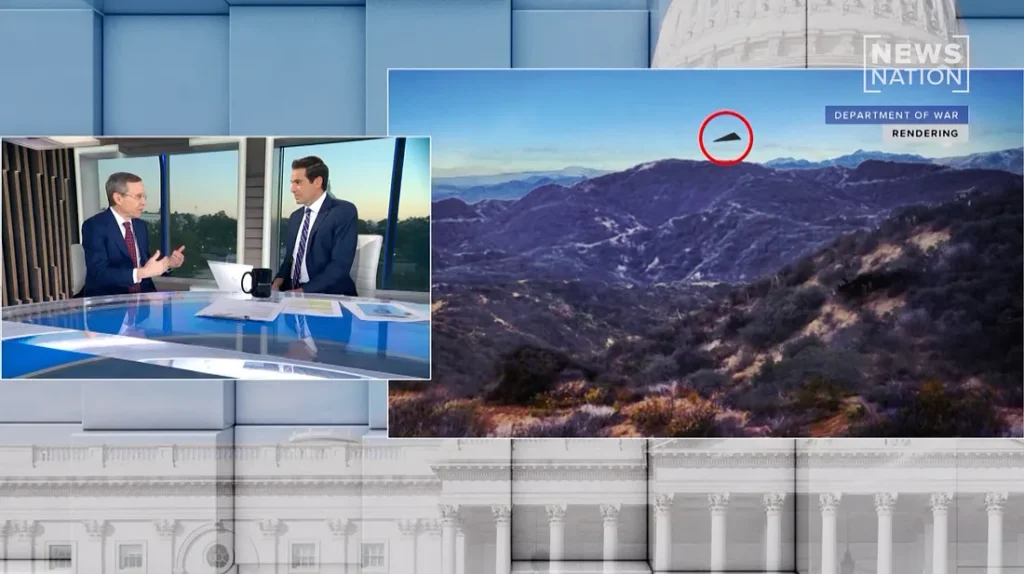
Below is a transcript of my in-person television interview with Blake Burman in The Hill on NewsNation on October 23, 2026. The interview is also available in video format here. In what follows, Blake’s questions are marked with BB and my answers with AL.
BB: Joining us now, Avi Loeb. He is a professor at Harvard University, also the chair of the UAP Science Advisory Council. So nice to see you. Good day to have you here in Washington. Thanks for coming in. Let’s go back to those flying triangles. What’s your theory? What do you think?
AL: We don’t know what they are. There are two types of objects that are being spotted by the Pentagon and the intelligence community: orbs and triangles, and they are hovering over strategic assets. We need to know what they are, because if you have a down-to-earth approach, you would say they are coming from adversarial nations. It is not our government that is flying them.
We shot down a Chinese spy balloon in 2023. And when I go to the kitchen and find an ant, I get worried because there must be many more ants under the sink. For the same reason, we need to figure out these objects. We won’t be able to do it based on the data that we’re given in these UAP tranches. It’s not good enough. My hope is to partner with the Pentagon and put better sensors at the locations where these objects are found.
BB: How are government officials talking and thinking about all of this?
AL: Well, there are definitely objects that both the Pentagon and the intelligence community cannot identify. And there is even a more fundamental question, because there are some reports from people who used to work in government that perhaps there are even alien spacecraft that are being held by corporations like Lockheed Martin.
I haven’t seen any evidence for that, and the officials I speak with have not seen any evidence for that. But if it exists, my plea to whoever owns them is, please take me to the nearest alien spacecraft, because I can help you figure it out. However, it may not exist.
It’s a win-win proposition to study UAP and get better data, because we will either help national security or make the biggest discovery ever made in science.
BB: My question that I keep on asking, because a lot of this is happening over military sites, is as follows: “Is this something that our military is testing on ourselves or is it adversaries potentially testing on us?”
The head of NASA, Jared Isaacman, was on the show a couple of weeks ago. I asked him a form of that question. It was: “Is this an adversary that’s testing some next generation propulsion? It’s certainly in the realm of possible. What does your gut tell you?”
Jared Isaacman replied: “I would say I would lean towards it’s either some phenomenon that can happen. There are things that can happen just like natural phenomena that can be observed. I also think there’s a good chance that there could be a Sputnik moment that’s happening and people are testing new stealthy or next-generation type technologies.”
Where do you come down between the Sputnik moment, natural phenomena, and then maybe as some of this extraterrestrial?
AL: I’m open-minded. The good thing about being a scientist is that you don’t need to know the answer in advance. In politics, very often you need to pretend to know the answer. But in my profession, we can collect evidence that will guide us. It’s like a detective story. And my recommendation is to put sensors in those locations, get better data, and figure it out like a detective. Eventually, all of us will be on the same page. You know, there are believers, there are skeptics. I’m threading in the middle between them. Both of them don’t like my approach, because they have already decided what these objects are.
BB: As part of the files released by the Pentagon today, there is a 2002 witness account from the military officer who claimed he was present in Roswell, New Mexico in 1947, and is quoted as writing or saying: “Samples of wreckage were around the table. It was unlike any material I had ever seen in my life: pieces which resembled the metal foil, paper thin, yet extremely strong, no one was able to identify the crash debris.”
That was part of the release today. Obviously, this is the incident that has captivated so many. What say you?
AL: There are always black projects that we are not aware of, engaged in developing future technologies that you can’t find in the commercial sector. For example, when the B2 bombers were tested, a lot of people thought that they were UFOs.
The challenge is to distinguish between future technologies that are currently being developed and civilians do not know about them, and actually truly alien technology, not human in origin, which might be orders of magnitude beyond what we can accomplish right now. Obviously, if we have debris of the material, we can immediately tell. But otherwise, it’s really important to separate the two. Anything that was manufactured by U.S. sources should be known to the intelligence community and the Pentagon. So, when they say something is an unidentified object, they mean it’s not from us.
BB: Let me leave you with this, chair of the UAP Science Advisory Council. This is now the seventh release. We still don’t have a `Yes’ or `No’ that the government has some answer. Do you think we’ll ever get that?
AL: I hope so within a year or two. And I hope President Trump will have the privilege of announcing whatever we find. Stay tuned! It’s a work in progress.
BB: All right. We’ll leave it there. Avi Loeb, Professor of Science from the Department of Astronomy at Harvard University. Very nice to see you. Thanks for being back.
Authorized publication by Dr.Avi Loeb