 Este artigo foi escrito originalmente em inglês.
 Ler em Português

The first generation of stars formed out of pristine gas of hydrogen and helium, the primordial gas left over from the Big Bang; for details, see my textbooks titled “How Did the First Stars and Galaxies Form?” here and “The First Galaxies in the Universe” here. Nuclear fusion in the interiors of these stars created heavier elements leading all the way to the most stable nucleus in nature, iron. Since life-as-we-know-it relies on carbon and oxygen, our cosmic roots stem from the nuclear fusion reactions in the hot cores of these first stars.
The nuclear burning ultimately converted the initial fuel of early massive stars to heavy elements, with the most stable element, iron, in the middle, surrounded by “onion shells” of progressively lighter elements in the outer layers. The envelope of heavy elements was expelled to interstellar space through supernova explosions once the nuclear fuel was consumed and the core collapsed to the scale of a city — ejecting the outer envelope through the release of its acquired gravitational energy.
In a Nature paper (accessible here) that I co-authored in 2003 with my former postdoc, Volker Bromm, we explained that the first stars in the Universe should have been much more massive than the Sun. Inefficient cooling of the primordial gas through molecular hydrogen yielded fragmentation into clumps, each with at least a few hundred solar masses. But as soon as the primordial gas was enriched with heavy elements by supernova explosions to a carbon or oxygen abundance as small as ~0.01% of that found in the Sun, cooling by carbon or oxygen atoms could have led to the formation of low-mass stars by allowing fragmentation to smaller clumps.
The earliest supermassive stars of a few hundred solar masses were short lived, lasting only a few million years and leaving behind black holes. But stars with a mass comparable to that of the Sun may still be around today.
The atomic cooling by carbon and oxygen naturally accounts for the known population of solar-mass stars in the halo of the Milky-Way galaxy with extremely low iron abundances but with a modest carbon abundance. Such stars are deficient in iron and may therefore be regarded as `anemic’. But their substantial carbon content explains how atomic cooling led to their formation.
How did their unusual abundance pattern form? Carbon-enhanced, iron-deficient stars could have been enriched by a supernova explosion that ejected the outer layers of a dying star, including carbon, while draining most of the iron in its core into a black hole.
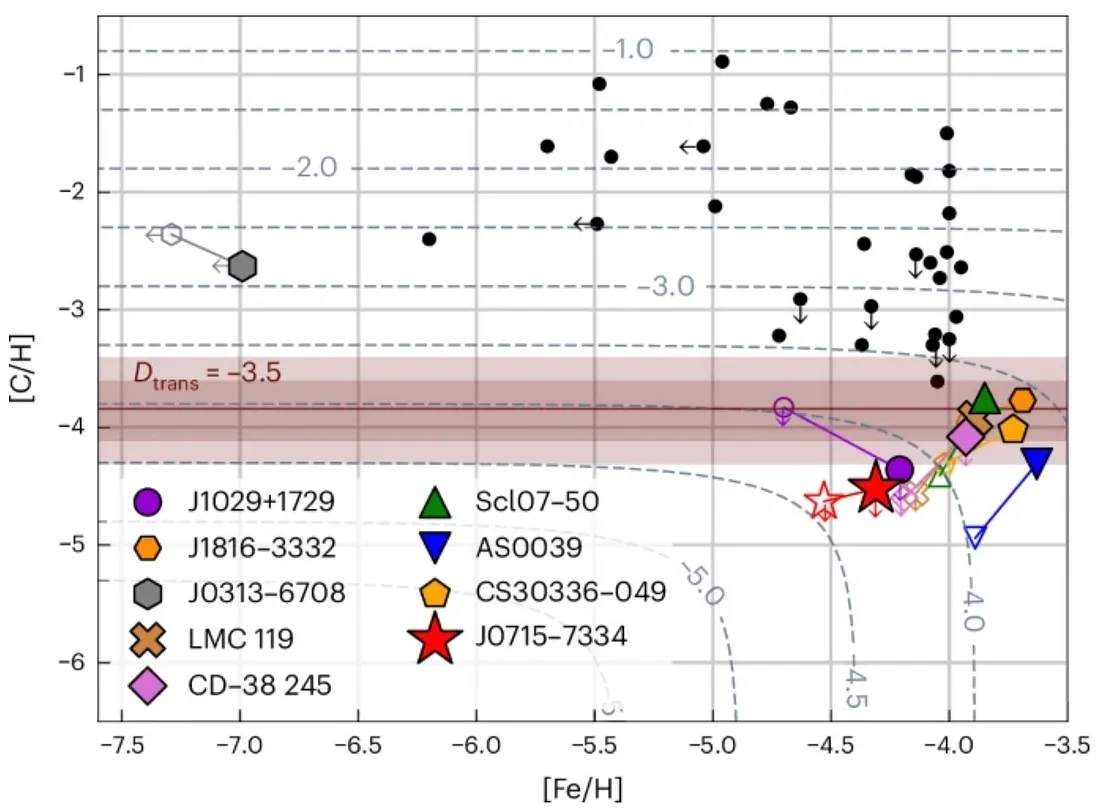
This week, a new Nature paper (accessible here) reported the discovery of the most metal-poor star known, SDSS J0715−7334. This cool, red-giant star with a surface temperature of 4,700 degrees Kelvin, shows an iron abundance which is 10^{−4.3} of the solar value and a carbon abundance that is 10^{−4.5} of the solar value. It is deficient in both iron and carbon.
Altogether, the heavy elements make up a tiny fraction, 7.8 × 10^{−7}, of the total mass of the star, requiring a formation channel mediated by cooling of dust particles, since atomic cooling is not sufficiently effective. The heavy element abundance pattern of the star can be explained by a primordial supernova explosion of a progenitor star with an initial mass of 30 solar masses. The orbit of the star implies that it originates from the halo of the Large Magellanic Cloud.

The star SDSS J0715−7334 is much more chemically pristine than the earliest galaxies discovered so far by the Webb telescope, with the record holder galaxy — reported here — found when the Universe was 280 million years old — merely 2% of its current age. When I started this field of research in the early 1990s, the earliest galaxies known were a few billion years old. The Webb telescope pushed the time horizon of known galaxies by a factor of ten closer to the Big Bang.
My theoretical work over the past three decades forecasts that the earliest stars formed about 70 million years after the Big Bang, so there is discovery room left to more ambitious space telescopes. Their future data will hopefully shed new light on the scientific version of the story of genesis: “Let there be light.”