Este artigo foi escrito originalmente em inglês.
 Ler em Português
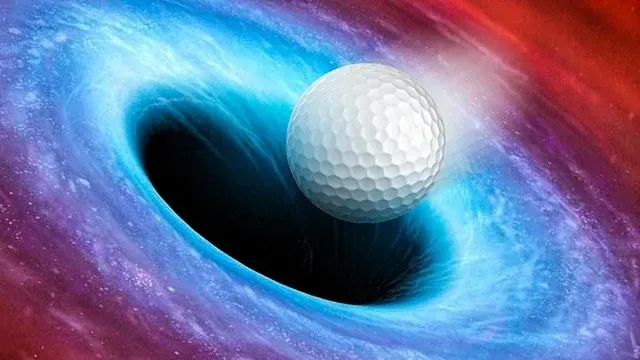
The one-way light travel time from Voyager 1 to Earth is currently 23 hours and 39 minutes. It will officially reach the milestone of 1 full light-day on November 18, 2026. If Voyager had carried astronauts, it would have taken them two days to get a reply from us to their prompt.
Voyager 1’s current distance is 25.53 billion kilometers or 170.68 times the Earth-Sun separation. Interstellar trips that extend well beyond that distance, require autonomy over local decisions. Instead of relying on NASA’s control center, an interstellar spacecraft must have its own independent brain, just like a child leaving home towards a remote destination. This necessitates the use of artificial intelligence (AI) in our future missions to interstellar space. Unfortunately, AI was not available when Voyager 1 was launched. We will celebrate the 50th year anniversary of this launch next year, on September 5, 2027.
The radioisotope thermoelectric generators (RTGs) on Voyager 1 may supply enough electric power to return engineering data for another decade. As it travels through the Oort Cloud of the Solar System and eventually into interstellar space, it will plow through the rarefied interstellar medium but will not be damaged much as a result of impacts of micrometeorites or dust particles. This is because its modest speed relative to the Local Standard of Rest of the Milky-Way galaxy, 32.4 kilometers per second, is just about 0.001 of the speed of light. Voyager 1’s net velocity combines its 17 kilometers per second ejection velocity from the Solar System with the Sun’s velocity relative to the local Galactic frame.
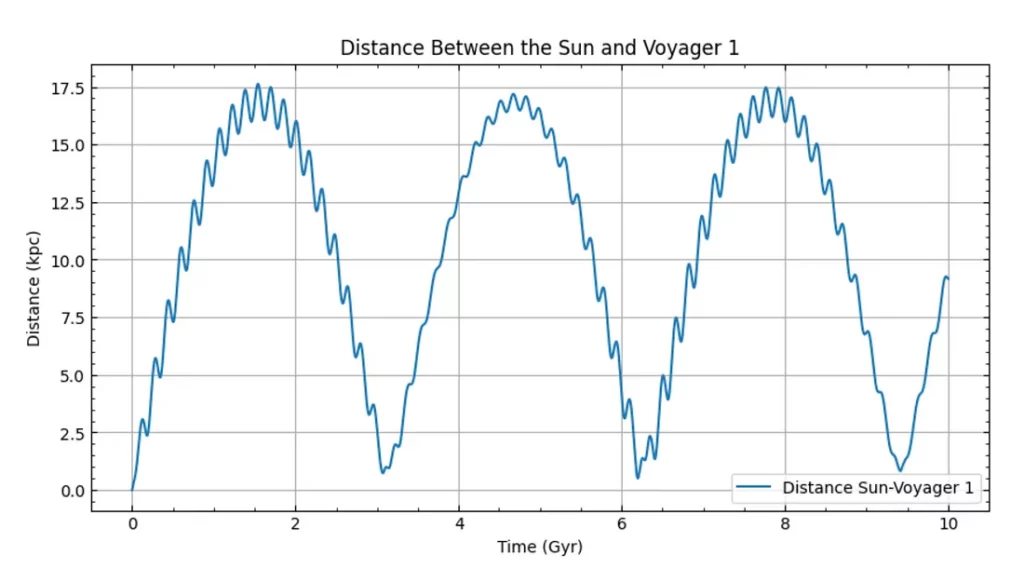
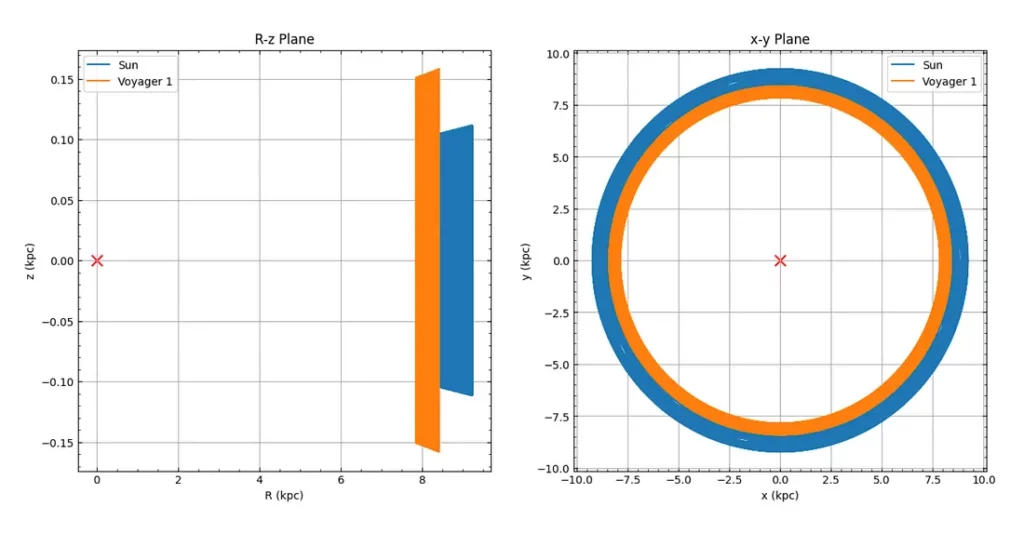
The local speed of Voyager 1’s is an order of magnitude below the Galactic rotation speed of the Sun around the Milky-Way center, 240 kilometers per second, as measured by my colleague Mark Reid here. This means that Voyager 1’s orbit will deviate from a perfect, circular path around the Milky-Way center. The actual motion can be split into a smooth guiding center moving in a perfect circle, and a local oscillation around that guiding center, commonly named as an `epicyclic oscillation’. Over a period of a billion years, Voyager 1 will drift to the opposite side of the Milky-Way relative to the Sun, as I calculated with my student Shokhruz Kakharov here.
The Milky-Way disk hosts 30 billion Sun-like stars. The latest data from exoplanet surveys suggest that about a tenth of these stars host an Earth-mass at roughly the Earth-Sun separation. Cosmic modesty argues that similar circumstances should lead to similar outcomes. Starting with a soup of chemicals in liquid water, the surfaces of such planets could give rise to space programs like NASA which launch Voyager-like spacecraft into interstellar space.

Half of the Sun-like stars formed about 2 billion years before the Sun (as reviewed here). If a tenth of these stars led to space agencies that launched N Voyager-like spacecraft, then there is a population of 150*N million Voyager-like spacecraft bound gravitationally to the disk of the Milky-Way galaxy. Most of the civilizations which launched the spacecraft are probably dead by now. Searching for radio signals from them is therefore hopeless. However, their packages might be traversing our Galactic backyard over and over again as defunct interstellar objects. Their technological debris accumulated over time in interstellar space like plastics in the ocean. As such, they offer testimony to interstellar archaeologists and historians about the technological history of the Milky-Way. We might be remembered in the history books of the Milky-Way thanks to all the interstellar probes we launch before the inevitable death of our civilization.
So far, NASA launched 5 interstellar probes over the past 50 years: Voyager 1 and 2, Pioneer 10 and 11 and New Horizons.
If a typical civilization pollutes interstellar space with ten million interstellar probes during its lifespan and they all become defunct space trash, then the nearest one would be currently at a distance of 15 light-days from us! This is only 15 times farther than Voyager 1 and well within the Oort Cloud.
Moreover, if a substantial fraction of the spacecraft is still active and some target the habitable zone of the Solar System for its resources, then we could find interstellar tech near Earth right now, for the same reason that bees cluster near a flower.
There is no need for faster than light travel in order for probes to reach us from the other side of the Milky-Way. It is sufficient to use rocket technology from the 1970s, like Voyager-1.
The Galileo Project (https://galileo.hsites.harvard.edu/) as well as the UAP Science Advisory Council under my leadership (https://uapsac.com/), are open-minded to this possibility.
***
Let me close with an anecdote. My brilliant colleague Mark Reid told me that the physicist Roy Kerr who derived the spacetime of a spinning black hole, asked him: “how many golf shots would it take to get a ball to the Galactic Center?” Mark correctly realized that it is sufficient to hit a ball in the opposite direction to the Galactic rotation until the orbital rotation was removed and the ball would just fall straight towards the Galactic Center. Assuming that a top PGA-tour kick adds 80 meters per second to the ball, I calculated that this task requires 3,000 shots. A hit every 30 seconds would consume merely a day of golfing in space to cancel the Galactic rotation speed of 240 kilometers per second.
It would then take another 50 million years for the golf ball to reach the black hole at the center of the Milky-Way, Sagittarius A*.
A typical golf course has 18 holes. What an amazing interstellar golf tournament would it be if all technological civilizations competed in the field of the Milky Way by trying to kick their golf balls into the one black hole at its center!
A follow-up question then naturally arises: which fraction of the interstellar matter accreted currently into Sagittarius A* is in the form of interstellar golf balls? Answering this question should be the next goal of the Event Horizon Telescope, led by members of Harvard’s Black Hole Initiative (https://bhi.fas.harvard.edu/), for which I served as the founding director a decade ago.
Assuming a few billion civilizations, each kicking a quadrillion golf balls during its lifespan, the average mass accretion rate of gulf balls over a period of 10 billion years is 10^{-17} solar masses per year, about a billionth of the current accretion rate into Sagittarius A*. To be competitive with the rest of the matter going down this hole, each civilization will need to kick 10^{24} golf balls, consuming about a percent of the Earth’s mass.