Este artigo foi escrito originalmente em inglês.
 Ler em Português
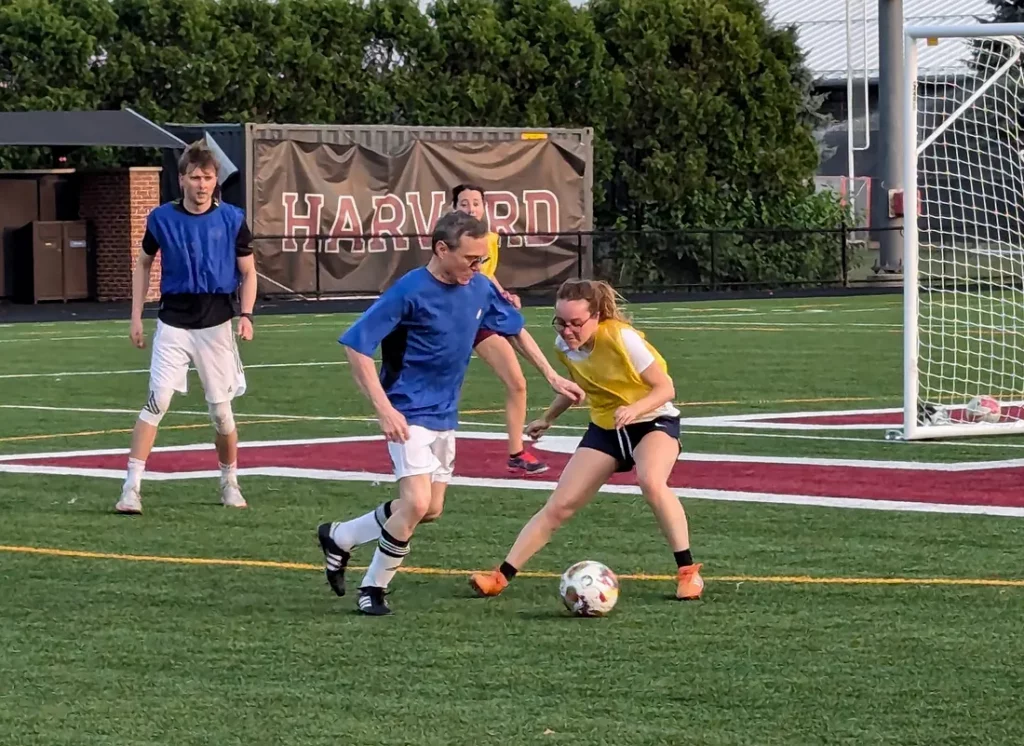
Consider the future a century from now when Elon Musk’s vision of occupying Mars will be fulfilled by a community of humans who relocated to Mars. Let us be optimistic and assume that this community was successful in employing robots with artificial intelligence for the construction of an underground infrastructure that protects them from the hazardous cosmic-rays and extreme temperature variations on the surface of Mars.
Let us further imagine that this infrastructure includes a soccer stadium at atmospheric pressure with volumetric fractions of 78.1% nitrogen, 20.9% oxygen, 0.9% argon, 0.04% of carbon dioxide and some traces gases — just like the terrestrial air.
In that case, the local Martian population could hold their local soccer matches. Even though these Martians originated from Earth, their physiology may evolve as a result of the surface gravity being 38% of Earth’s value.
At some point, the Martians will challenge Earthlings to have a Worlds Cup match in their home stadium. How difficult will the game be for our future Earth team composed of star players like Lionel Messi, Kylian Mbappé, Jude Bellingham, Lamine Yamal or Rodri?
The duration of a day on Mars resembles that of Earth, lasting 24 hours and 39:35 minutes, as both planets have a similar spin period and rotational tilt relative to their orbital plane around the Sun. Water ice from the Martian polar caps can be partially melted and served as refreshments to the players and the Martian audience.
While the match is transmitted live, Earthlings will view it somewhere between 3:02 and 22:24 minutes later, the time it takes light to traverse the changing distance between Earth and Mars. This means that Martians will cheer for a goal long before earthlings are aware of it. This will be the first instance where soccer fans will be made aware of the undeniable constraint imposed by the finite speed of light. Special Relativity will limit their quality of life, whether they like it or not. The players will not receive messages from their family members on Earth in real time and will have to patiently wait for at least double the light crossing time in order to have a meaningful exchange.
In preparation for the game on Mars, it would be prudent to send the Earth team to a training base camp on Mars well in advance. Kicking the ball at the same initial speed and direction will make it travel 2.63 times farther on the soccer field. For instance, a standard 50-meter pass of the ball on Earth would translate to 132 meters on Mars, well beyond the boundary of the soccer field. The Earth-based players will have to get used to weaker kicks. They will also find running much easier in a lower gravity, given their muscle strength.
The question of which team wins will depend on how the physical strength of the Martians deteriorated over their time away from Earth.
Gravity does not care about the mass of the soccer ball. At the end of the last Apollo 15 moonwalk, Commander David Scott dropped a 1,320-gram hammer and a 30-gram falcon feather at the same time. Because there was no air resistance the feather fell at the same rate as the hammer, just as Galileo Galilei concluded four centuries earlier.
As of now, what FIFA labels as the `World Cup’ is limited to Earth. This represents an inappropriately narrow view of the Universe. There are hundreds of billions of exoplanets in the Milky Way galaxy alone. A small fraction of them might be classified in astrobiology as `soccerable exoplanets’, a subcategory of habitable exoplanets with a manageable rocky surface and a reasonable surface gravity that allow the construction of a soccer stadium.
In 2014, a Sports Illustrated reporter contacted me with the news that the troubled FIFA president then, Sepp Blatter, hinted at the possibility of organizing an interplanetary contest, saying: “we shall wonder if one day our game is played on other planets and then one day we won’t have the World Cup, we will have interplanetary contests.” As chair of the Harvard Astronomy department at that time, I argued that arranging such a match would be very challenging. To validate my credentials, the reporter, Dan Treadway, posted photos of me playing soccer, available now here and here, and declared: “Case closed. Sorry, Sepp”.