 Este artigo foi escrito originalmente em inglês.
 Ler em Português
The chemistry of life-as-we-know-it requires carbon and oxygen. The universe spent only a few minutes at the high temperatures that enable fusion of protons and neutrons into carbon or oxygen and so it produced negligible amounts of these heavy elements shortly after the Big Bang. But a hundred million years later, the first stars condensed out of the primordial gas of hydrogen and helium and were able to produce carbon and oxygen in their interiors over millions of years.
These first stars were massive based on theoretical calculations that I performed with my students and postdocs thirty years ago (and are summarized in my textbooks “How Did the First Stars Form?” and “The First Galaxies in the Universe”). After burning their nuclear fuel of primordial hydrogen and helium for a few million years, they acquired a central temperature above a billion degrees, creating electron-positron pairs out of collisions of energetic photons, protons and electrons, in a process that removed their support by radiation pressure — leading to a runaway collapse and fast release of nuclear fusion energy which triggered an eventual explosion. The explosion left no remnant behind and enriched the environment with the heavy elements that were cooked in the interior of the progenitor star. This so-called “pair-instability supernova” is the only stellar explosion process which is fully understood from first principles. It was first described in a paper (accessible here) written by the Israeli astrophysicists Gideon Rakhavi and Giora Shaviv in 1967.

The ejected guts of the first stars were therefore the seeds of life-as-we-know-it. Our cosmic roots trace back to the spherical shells of ejecta from these first stars. The scientific version of the biblical story of genesis is not only about “Let there be light” but also about “Let there be carbon and oxygen”.
Staring at our body, we are seeing the reflection of light from heavy elements that were produced in the cores of massive stars that predated the Sun. We arrived late in cosmic history for a good reason: life was not possible before the first stars formed 100 million years after the Big Bang.
That the cosmos had to wait a hundred million years for abundant carbon and oxygen to be produced is unfortunate, because 15 million years after the Big Bang the entire Universe was at room temperature and could have supported life-as-we-know-it in liquid water everywhere if oxygen had existed back then. I pointed out this missed opportunity in a 2014 paper accessible here.
And so, when offered lemons, the cosmos makes lemonade. At the freezing cosmic temperature of 2.7 degrees above absolute zero today, life prospers in regions that are warmed up by nuclear furnaces like the Sun. Late stars like the Sun formed out of gas that was enriched in carbon and oxygen by earlier generations of stars, and leftover debris from their formation process condensed to make habitable rocky planets like the Earth, on the surface of which life could have formed out of a soup of chemicals in liquid water.
The Sun formed in the last third of cosmic history but most stars formed billions of years earlier. This is good news because it means that other technological civilizations may have predated us by more than a billion years — the time required for the Voyager spacecraft to cross the Milky-Way disk of stars. To find their Voyager-like spacecraft we need to engage in cosmic archaeology. This implies searching for technological artifacts that arrive to our cosmic backyard from interstellar space. Some artifacts may have collided with the Moon and are buried under lunar dust. As we establish a human base camp in the Artemis program, we should survey the lunar surface for any extraterrestrial technological objects that may have crashed on Moon over the past 4.5 billion years.
Finding packages from siblings in our Galactic family of technological civilization will provide us with a better perspective on our cosmic history and inspire us to venture into interstellar space as well.
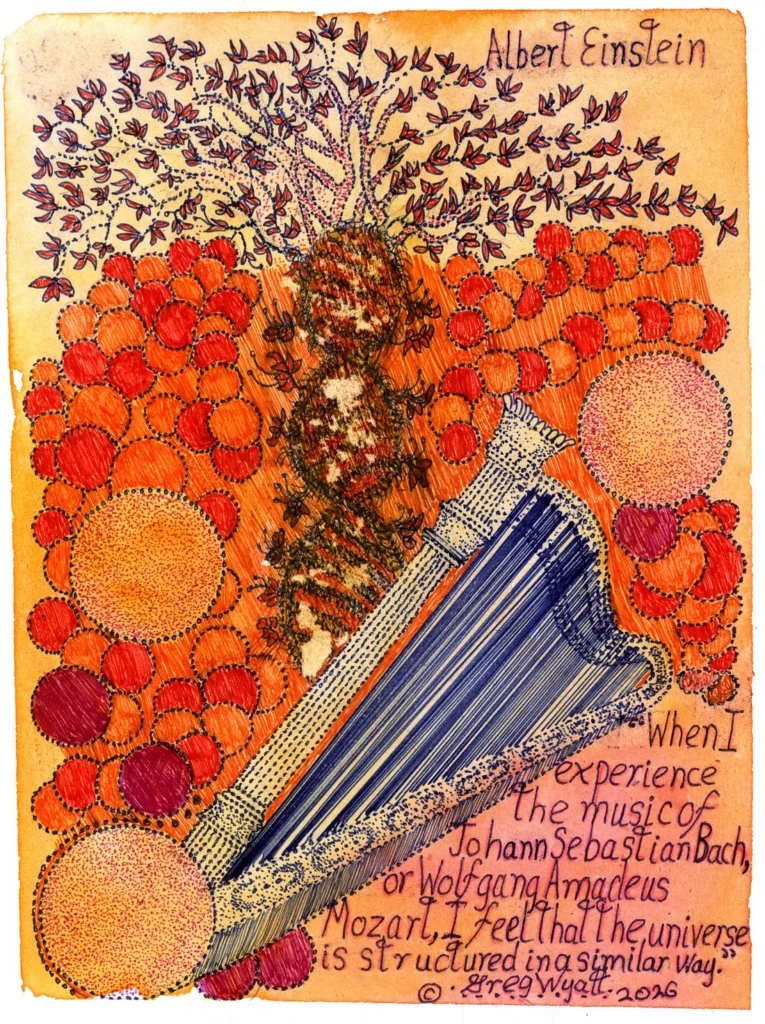
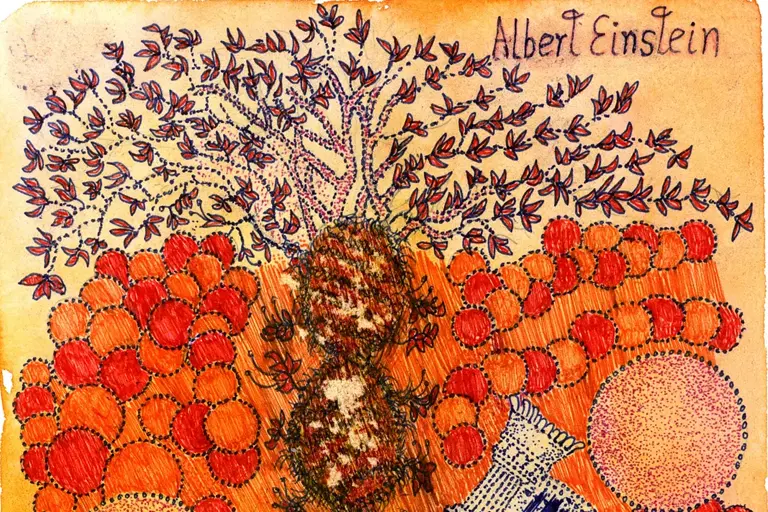
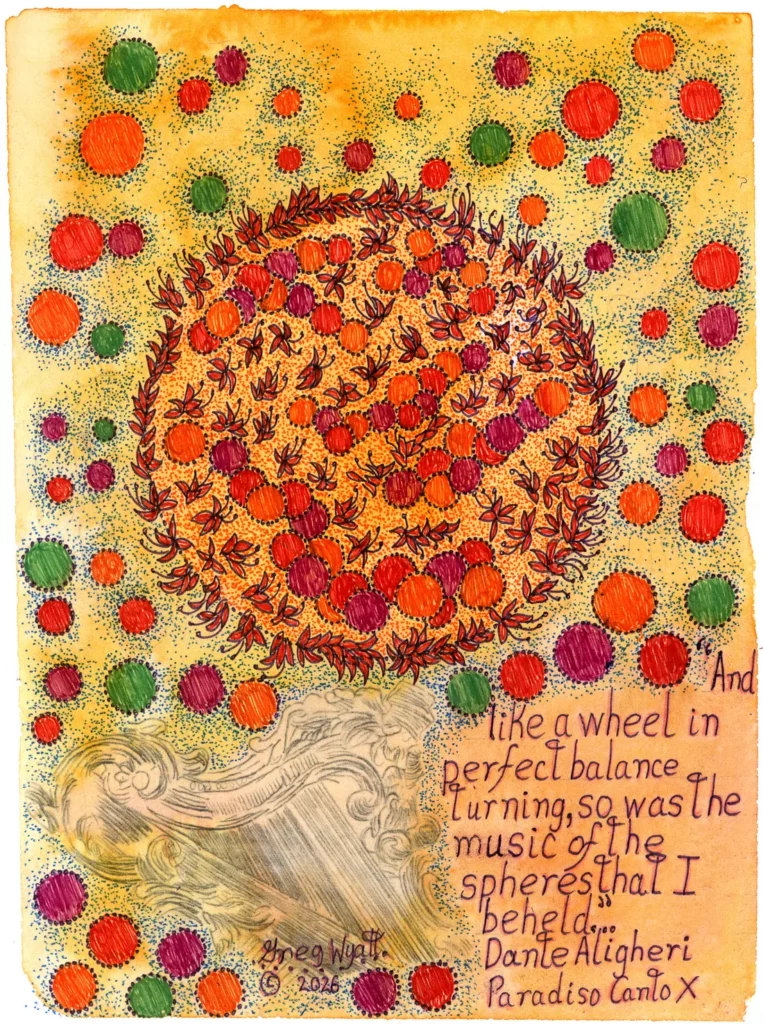
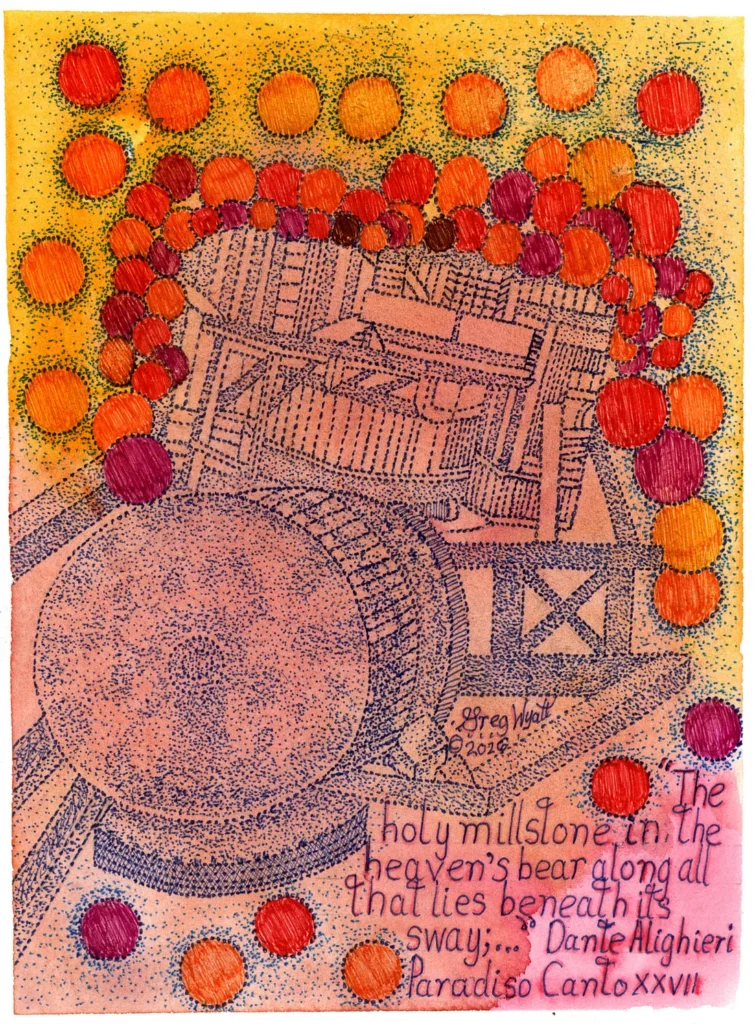
In this essay, I featured four amazing watercolors from a series created by the celebrated artist, Greg Wyatt. These watercolors incorporate inspiring statements by Dante Alighieri and Albert Einstein. This is the 15th in a sequence of essays, where Greg and I collaborate on the interface between art and science. The first essay in this series, titled “Music of the Cosmic Spheres,” appeared here; the second essay, titled: “Cosmic Waterfalls in Spacetime Cliffs,” appeared here; the third titled “Missing Elements in the Cosmic Jigsaw Puzzle,” appeared here; the fourth essay, titled: “Why Do We Exist?”, appeared here, and the fifth titled “Inspiration from the Stars”, appeared here, the sixth titled: “We Might Understand How the Cosmos Works Before We Understand How Life Works”, appeared here, the seventh titled: “Will the Human Survive for Billions of Years”, appeared here, the eighth titled: “The Butterfly Effect of Intelligence in the Cosmos”, appeared here, the ninth titled: “Benefits of Extraterrestrial Intelligence over AI”, appeared here, the tenth titled: “Übermenschen on Exoplanets” appeared here, the 11th titled: “If You Had an Infinite Research Budget, How Would You Allocate It?” appeared here, the 12th titled: “Are Human-Made Objects Orbiting Earth?” appeared here, the 13th titled: “Lets Send AI Astronauts, Not Humans, to the Moon”, appeared here, and the 14th titled: “Our Highest Priority Should be National Innovation Centers to Complement AI Data Centers” appeared here.