Este artigo foi escrito originalmente em inglês.
 Ler em Português
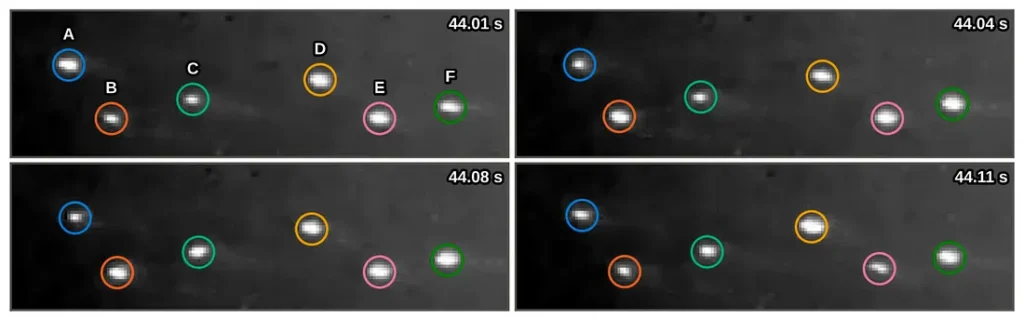
One of the most intriguing Unidentified Anomalous Phenomena (UAP) released by the Presidential Unsealing and Reporting System for UAP Encounters (PURSUE) on September 18, 2026, includes six dots in an infrared video recorded from a military aircraft over the Qaruh Island near Kuwait, labeled DOW-UAP-PR135. The mission report describes a group of six small objects moving at an estimated speed of 480 miles per hour.
The nature of these six dots has just been identified in a new paper, accessible here, co-authored by members of the UAP Science Advisory Council with Dr. Jacob Haqq-Misra as the lead author.
The executive summary of the paper is as follows. We measured the brightness of each object in every frame. All six infrared dots brighten and dim steadily at a rate of 7.1–7.9 times per second, each at its own rate and out of step with the others. Tests with constant-brightness objects planted in the video show that neither video compression nor the sensor produce this flicker. We applied the same analysis to recordings from a ground-based array of infrared cameras deployed by the Galileo Project near Las Vegas (as described here). The Galileo Project videos show several examples of birds with steady beats at 3.4–10.0 times per second, within the range of bird wing beats and compatible with the DOW-UAP-PR135 flicker. In addition, our paper shows that the apparent ground-projected speed of 480 miles per hour could be the result of parallax when tracking a nearly stationary group at 60–80% of the camera’s altitude. Given these inferences, we suggest that the six unidentified objects are best explained as a small flock of birds, flying nearer to the aircraft than assumed by the reporting crew. This scientific analysis demonstrates the value of periodic brightness variability for characterizing UAP even when the distance remains uncertain. Below are the full details on the context and analysis in this new paper.
***
Over the past five months, the U.S. Department of War released six tranches of UAP records under its PURSUE program, including dozens of videos from infrared cameras on military aircraft. Redactions to the on-screen displays restrict the information in these released videos, making it difficult to infer the nature of the UAP. None of the sensor videos released under PURSUE provide the distance from the sensor to the UAP, leaving the UAP velocity uncertain. Without knowing the range, the motion of a small object near the aircraft, such as a bug, a bird or a balloon, can appear similarly to a faster larger object farther away. For example, in the “Go Fast” video recorded by the U.S. Navy in 2015, an object that appeared to skim the sea at high speed was actually far above the sea and moving at about the speed of the wind. However, the data that were available to resolve the “Go Fast” case are redacted in PURSUE videos.
The intriguing video DOW-UAP-PR135 was released together with a mission report DOW-UAP-D108, filed by a U.S. Air Force crew for a sighting on 29 July, 2025. The report describes six small objects grouped together, that “seemed to be agile, frequently changing direction” and were “able to change directions quickly and simultaneously.” The report lists the estimated velocity of 480 miles per hour, equivalent to 63% of the speed of sound (or 215 meters per second), at an estimated altitude of 6.7 kilometers.
Birds can be recognized by their wingbeat. A flapping wing changes the projected surface area of the bird facing the camera, which modulates the bird’s infrared brightness at the wingbeat frequency or at twice that frequency. For birds in cruising flight, wingbeat frequencies range from about 2.5 beats per second for the largest birds to more than 10 beats per second for small songbirds. The frequency of such a beat does not depend on the distance, so it can be measured even when the distance is unknown.
Our paper performs a frame-by-frame analysis of the brightness and apparent size of each of the six objects in the footage of DOW-UAP-PR135. Every object beats steadily at 7.1–7.9 Hz, each independent of the others. Analysis of each beat eliminates video compression, pixel sampling, and sensor defects as explanations. We then apply the same frame-by-frame analysis to infrared video of flying animals from the ground-based camera array of the Galileo Project near Las Vegas, described here, and find several examples of objects with flicker at bird wingbeat frequencies. Finally, our paper shows that a stationary or slowly moving object at 60–80% of the aircraft’s height is consistent with the reported speed estimate of the objects. When combined, these results provide compelling evidence that the objects in DOW-UAP-PR135 constitute a small flock of birds. This underscores the value of performing time-domain analysis of the characterization of UAP, as the beat frequency does not depend on distance and can be applied in cases even when sensor telemetry or aircraft altitude data are redacted.
The DOW-UAP-PR135 video shows six compact warm dots that cross the field of view together. It would have been challenging to explain these dots as coordinated drones moving at 480 miles per hour because the limited communication rate of drones would risk collisions among them. The eyes and natural brains of birds operate at a higher rate, making their coordinated motion feasible. The infrared dots move relative to one another by tens of pixels within a couple of seconds, so that the group appears in turn as a line, a clump, pairs, and a loose ring. Each object brightens and dims repeatedly. The brightness of the objects beats in the narrow range of 7.11–7.85 beats per second, with amplitudes of 12–26% about the mean, and each beat stands 100–280 times above the median level of the background power spectrum of temporal fluctuations. In addition to brightness, the same beat also appears when measuring each object size in pixel area as well as its fitted Gaussian width. For every object, these three peak frequencies agree to within 0.13 beats per second.
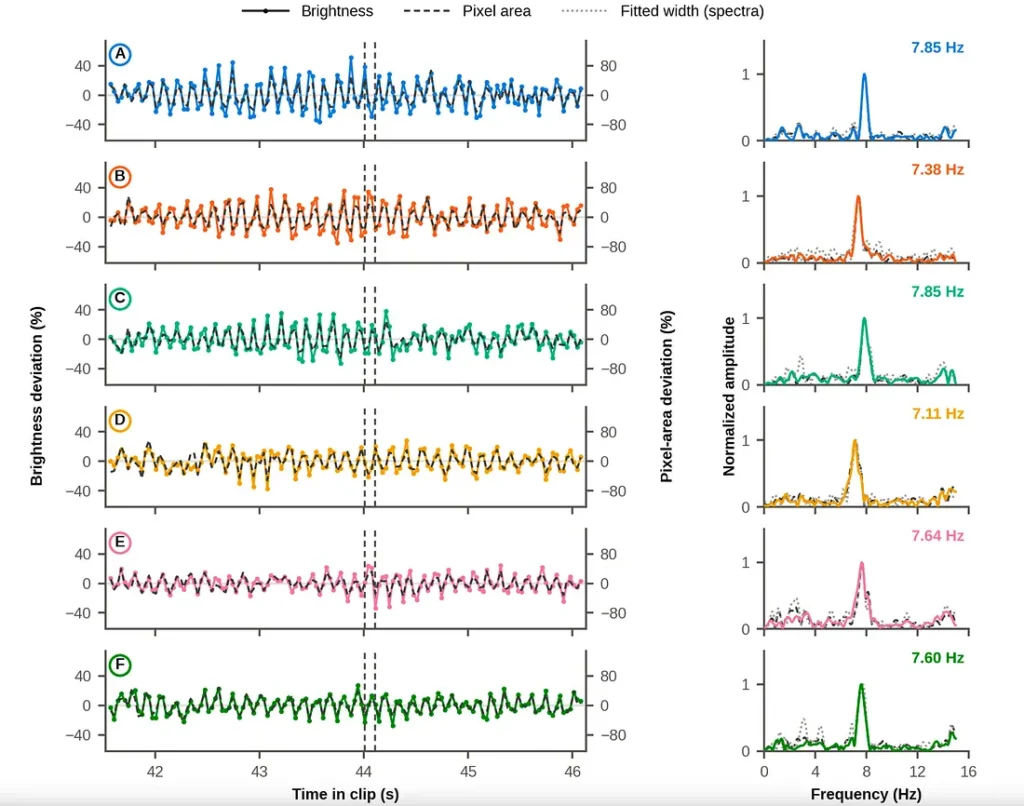
The six objects do not beat together, and their frequencies span a range of 0.74 beats per second. The objects labeled A and C beat 7.85 times per second, E and F show 7.60–7.64 beats per second, B shows 7.38 beats per second and D exhibits 7.11 beats per second. Over the same frames, the phases between any two objects are out of oscillation phase between 30 and 170 degrees in magnitude, with 8 pairs more than 90 degrees apart. Even A and C, which show the same beat frequency, are 119 degrees apart. This eliminates video flicker as an explanation, as a beat produced by the video itself would reach all six objects at one frequency and in one phase.
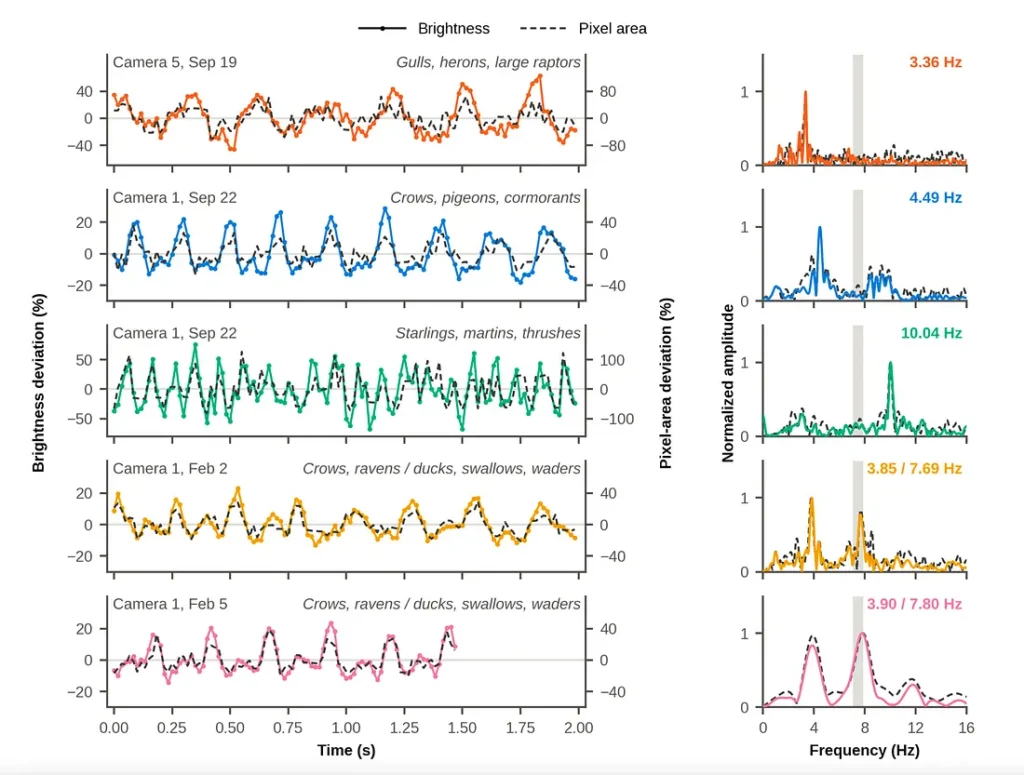
A steady beat of the observed kind could be produced by flapping wings. We demonstrated that by applying the same frame-by-frame analysis to infrared videos of the sky recorded by the Galileo Project (as described here). We were easily able to locate numerous flying animals in the evenings and mornings, all of which beat steadily in brightness and size together during the entire time on camera. The flyers detected by the Galileo Project infrared cameras show 3.4–10.0 beats per second, within the observed wingbeat frequencies of birds in cruising flight. The beat frequency provides constraints on the kinds of bird in a given observation, although this does not necessarily constrain uniquely particular species. The comparison to the Galileo Project data shows that this frame-by-frame analysis method is able to recover a steady beat frequency from birds, with a size and brightness similar to the six infrared dots in DOW-UAP-PR135.
The DOW-UAP-D108 report mentions a speed estimate without a distance measurement.
The reported speed of the UAP is what a slow flock of birds at 60–80% of the recording aircraft’s height would produce when no range is measured. The birds are nearer to the aircraft than the ground point on which the speed was estimated. The number of objects, their changing arrangement, and the report’s description of objects that were agile and changed direction, are all consistent with this interpretation.
The flicker frequencies of the six objects lie within the range measured for birds in cruising flight. Birds are known beat their wings faster in thinner air. Among nocturnal migrants tracked by radar, the wingbeat frequency rose by 0.4 hertz (beats per second) per kilometer of altitude in flap-gliding birds and by 1.1 hertz per kilometer in bounding birds. This suggests that birds at the inferred altitude of up to 3 kilometers could beat about 3 hertz faster than the same birds near sea level. The frequency alone does not constrain a species. Six birds flying together would be expected to beat at similar but not identical rates and out of phase, as observed in DOW-UAP-PR135.
The limits of the above analysis are posed by the absence of sufficient data, in particular the altitude of the camera. Conclusive results require access to aircraft location, sensor telemetry and unredacted video, so that inferences can be vetted rather than left to ambiguous interpretation.
The specific location of the video footage is Qaruh Island near Kuwait, identified in a Google Map here. When the DOW-UAP-PR135 infrared video was taken in July 29, 2025, the skies and waters surrounding Qaruh Island were predominantly occupied by breeding seabirds, specifically four core species of terns and visiting Socotra cormorants. Late July represents the peak summer breeding and nesting season for these specialized marine birds on Kuwait’s southern subtropical coral cays.

UAP are a mixed bag, with most objects being natural or human made. But even if one in a million UAP represents a non-human technological origin, this one object would constitute the biggest discovery ever made by humanity. Such a discovery can only rest on the solid foundation of exquisite scientific data, not on the fleeting opinions expressed on social media.
Authorized publication by Dr.Avi Loeb