Este artigo foi escrito originalmente em inglês.
 Ler em Português
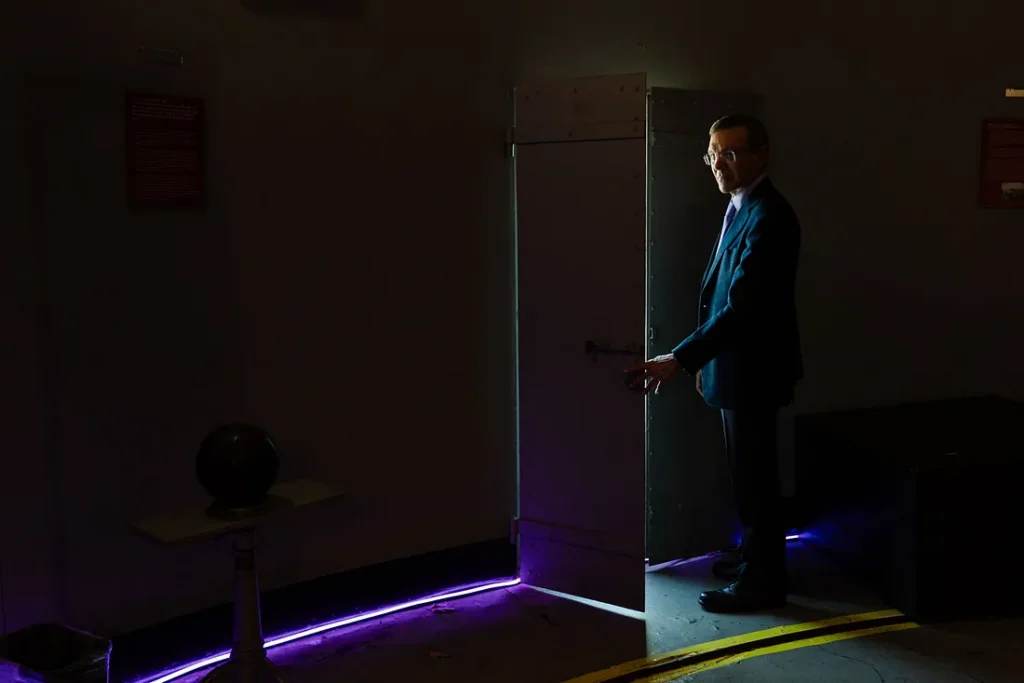
Just after sunrise today in Austin, Texas, I woke up to the pinging sound of my laptop, as the investigative reporter Ilan Greenberg sent me this link for his POLITICO magazine feature article with the accompanying sentences: “This has been one of my most memorable reporting encounters. I do hope I can write about you again.”
The previous night, I attended the banquet dinner of the Texas Tribune Festival. I am not a social animal and usually rely on my wife for interactions with strangers. But during the pre-dinner cocktail, a fascinating woman approached me out of the blue and her name tag read Gina Ortiz Jones. She said: “Hello, Avi. I am the mayor of San Antonio. What brings you to Austin and what is the latest update about the Universe?”
At dinner, I was fortunately seated next to Dr. Craig Cummings, co-founder of Moonshots Capital, who instantly identified my ethnic origin based on his experience as a veteran intelligence officer at the National Security Agency. As I was informing Craig about my latest research on Unidentified Anomalous Phenomena (UAP), he pulled out his phone and initiated a FaceTime session with his wife, Lawton. She looked at the two of us staring at the camera and said: “Oh my God, I cannot believe that you are speaking with Avi Loeb. I have been following him for years. I will attend his panel discussion tomorrow!”
While waiting for dinner to be served, I received an email from Dr. Jacob Haqq-Misra, a member of the UAP Science Advisory Council who analyzed a video of 6 dots in the sky released a week ago by tranche 6 of the Presidential Unsealing and Reporting System for UAP Encounters (PURSUE). Our collaborative analysis reveals the fundamental nature of these mysterious dots. More about that when we finish writing the related scientific paper.
On my other side at the dinner table was the CEO of the Texas Tribune, Sarah Adler Hartman, who explained how important it is for journalists to follow facts and not necessarily cater to the wishes of the audience. This is why the Texas Tribune is a non-profit organization, funded by donations. I echoed her sentiments by noting that the same is true about practicing science. My research over the past decade has only been funded by donations with no strings attached. She replied: “My husband, Matt, and I will do our best to attend your panel discussion tomorrow!”
The reason I visited Austin was an invitation to speak in a panel discussion with Eric Berger and the moderator Matt Ewalt about `Space: The Final Frontier’. The forum was held at the Bethell Hall of the St. David’s Episcopal Church. In my native language of Hebrew, Bethell means the house of God, the second time I heard the word `God’ during this visit.
As I left the hotel on my way to my session at the Church, a person from the street approached and asked me to sign my name on an enlarged photo of myself and let him take a selfie with me. He was waiting for me to come out of the hotel after watching me twice on the Joe Rogan Experience, recorded during my previous two visits to Austin.
The hour-long panel discussion and audience Q&A that followed it were fascinating. They covered all aspects of space exploration, including scientific, national, military and commercial perspectives. Eric Berger, who started his academic education in astronomy at the University of Texas in Austin, approached these space topics from the establishment point-of-view and I did so from the curious, heretic and visionary point of view.
When asked about the future space aspirations of humanity, I explained that launching self-replicating AI robots to space would enable interstellar travel. An annual investment of a trillion dollars (comparable to the annual U.S. military budget) could bring humanity by the end of this century to developing a city-size space platform that can accommodate humans or their technological avatars on interstellar trips. This would be a manifestation of Noah’s Spaceship to save humanity from a future catastrophe on Earth, analogous to Noah’s Ark — designed to save life forms from the Great Flood. Nobody would mourn humanity if it disappeared from the face of Earth like many other species in Earth’s history. It remains our own wish to extend the longevity of our species beyond our planet. The Moon or Mars are not good replacements to Earth and humans cannot survive for a long period of time in these harsh environments.
Matt Ewalt asked me about the political aspects of my scientific research, and I explained that science transcends political or financial incentives. Tech entrepreneurs are often watering the branches of the tree of knowledge because they profit financially from picking up their fruits — AI or quantum computers. However, they forget that these technologies emerged from the roots of fundamental science, and the physicists who discovered the underlying principles that enabled their wealth, were paid very little — about a million times less than the net worth of some of these entrepreneurs. I am not asking these entrepreneurs to apologize for their wealth but rather to be grateful to the scientists who discovered quantum mechanics and solid-state physics, as these individuals ushered in the computer chips of today. This means that we should not only water the branches of the tree of knowledge with the unrealistic hope that it will continue to blossom. Instead, we should water its roots of fundamental science.
In reciprocity, scientists should engage in research that is of interest to society because science is funded by taxpayers. Science is not supposed to be entirely detached from the interest of the public. The frontiers of theoretical physics cannot engage in mathematical gymnastics of 10–26 dimensional spacetime for fifty years without reflecting on how they lost their way.
At the same time, the U.S. government reports about Unidentified Anomalous Phenomena (UAP) — an admission that attracts unprecedented attention from the public. Under these circumstances, scientists have the obligation to resolve the UAP mystery because at the very least — in doing so, they will help the Pentagon and the Intelligence Community fulfill their missions. UAP research is a subject that all Americans are interested in, irrespective of political affiliation.
UAP research transcends politics and holds the potential to replace international relations with interplanetary relations. Assuming we are not alone in our cosmic neighborhood, it is our scientific obligation to find our cosmic neighbors. Of course, finding them can only expand our aspirations for space exploration.
Authorized publication by Dr.Avi Loeb