Este artigo foi escrito originalmente em inglês.
 Ler em Português
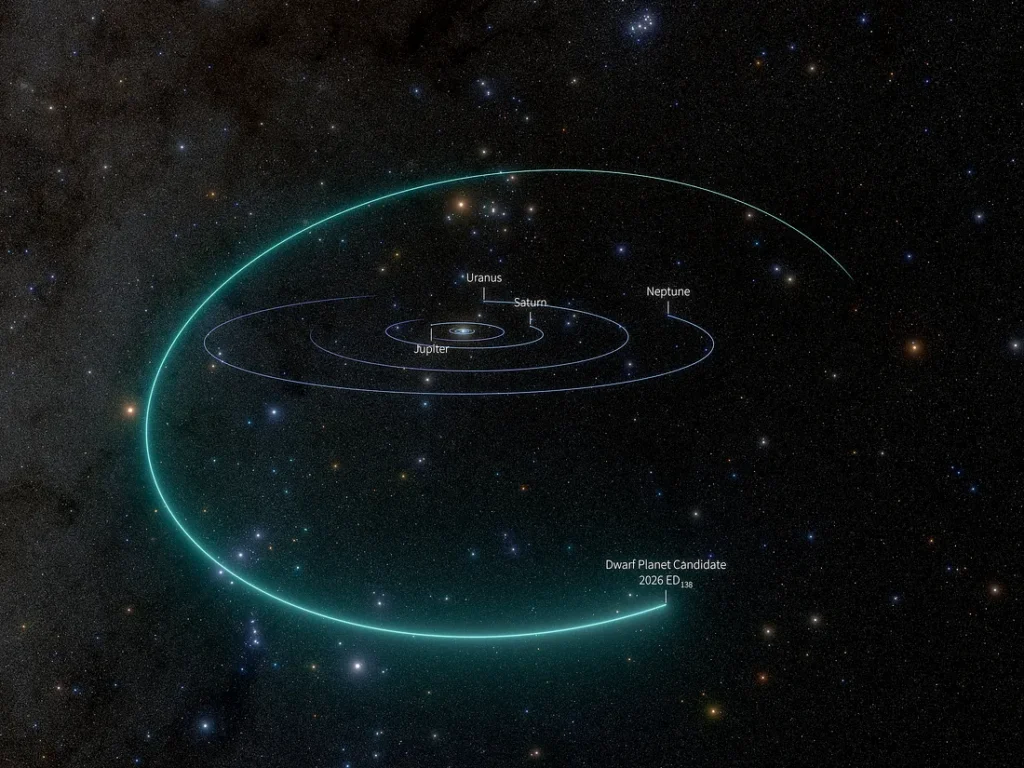
The NSF–DOE Vera C. Rubin Observatory discovered a new dwarf planet candidate, named 2026 ED138, in the outer Solar System beyond the orbit of Pluto. The observational data was announced today (October 27, 2026) here by the International Astronomical Union Minor Planet Center (MPC).
If confirmed, ED138 would be among the largest and brightest bodies known in this outer Solar System. A dwarf planet is an object massive enough for its self-gravity to make it nearly spherical. Based on ED138’s distance, brightness and estimated surface reflectivity (albedo), its size is estimated to be in the range between 600 and 1500 kilometers. Icy bodies this large are expected to be round.
ED138 was first identified by Matt Holman, my colleague at the Center for Astrophysics | Harvard & Smithsonian. The related Rubin Observatory data was obtained during the run up to the Legacy Survey of Space and Time (LSST). On the evening of October 13, 2026, Holman was running data collected by Rubin earlier in 2026 through a search code he developed with Kevin Napier. The code searches through billions of detections of moving objects and compares them to identify those corresponding to the same object.
To verify the validity of the discovery, a detailed search through Rubin’s catalogs and images was subsequently initiated by Mario Jurić, a former postdoc at Harvard’s Institute for Theory & Computation that I directed for 20 years, who is currently a faculty member at the University of Washington and Rubin Solar System Lead Scientist. Jurić found 20 more observations of ED138, dating back from July 11 to March 4, 2026. In total, ED138 was observed 30 times in 20 nights. Additional archival images of ED138 all the way back to 2016, were obtained by the Dark Energy Camera (DECam), mounted on the Victor M. Blanco 4-meter Telescope at Cerro Tololo Inter-American Observatory (CTIO), a Program of NSF NOIRLab. This data allowed the Rubin team to trace more than 10 years of ED138’s orbit around the Sun.
ED138 is currently at a distance of about 46 times the Earth-Sun separation (astronomical units=au), whereas the dwarf planet Pluto has an average distance from the Sun of 40 au. This makes ED138 a trans-Neptunian object (TNO), located beyond Neptune. ED138’s orbit is tilted by 25 degrees off of the plane of the Solar System planets, suggesting that it was shifted from the ecliptic plane by Neptune’s gravitational influence.
Infrared observations, potentially by the Webb telescope, are needed to constrain the exact size of ED138 and confirm its nature as a dwarf planet. Detecting the heat emitted by the planet would provide its surface temperature and allow the inference of its emitting surface area from its measured luminosity (based on its brightness and distance). If confirmed, ED138 would join the five officially recognized dwarf planets: Pluto, Ceres, Eris, Haumea, and Makemake.
ED138 is projected on the sky close to the plane of the Milky Way, which is crowded by numerous background stars. This coincidence projection explains why ED138 was not discovered until now. Rubin Observatory’s regular and continuous monitoring of the entire Southern Hemisphere sky, combined with powerful algorithms that sift through billions of light sources in search for small moving objects, enabled the discovery of ED138.
As Rubin will continue to image the entire Southern sky multiple times for ten years, it will likely find other new members of the solar system, as well as first-time visitors in the form of new interstellar objects like 1I/`Oumuamua, 2I/Borisov and 3I/ATLAS.
Context: The NSF–DOE Vera C. Rubin Observatory on Cerro Pachón in Chile is a joint initiative of the U.S. National Science Foundation (NSF) and the U.S. Department of Energy’s Office of Science (DOE/SC). The U.S. National Science Foundation (NSF) is an independent federal agency created by Congress in 1950 to promote the progress of science. NSF supports basic research and people to create scientific knowledge that transforms the future. The DOE’s Office of Science is the single largest supporter of basic research in the physical sciences in the United States.
Authorized publication by Dr.Avi Loeb