Este artigo foi escrito originalmente em inglês.
 Ler em Português
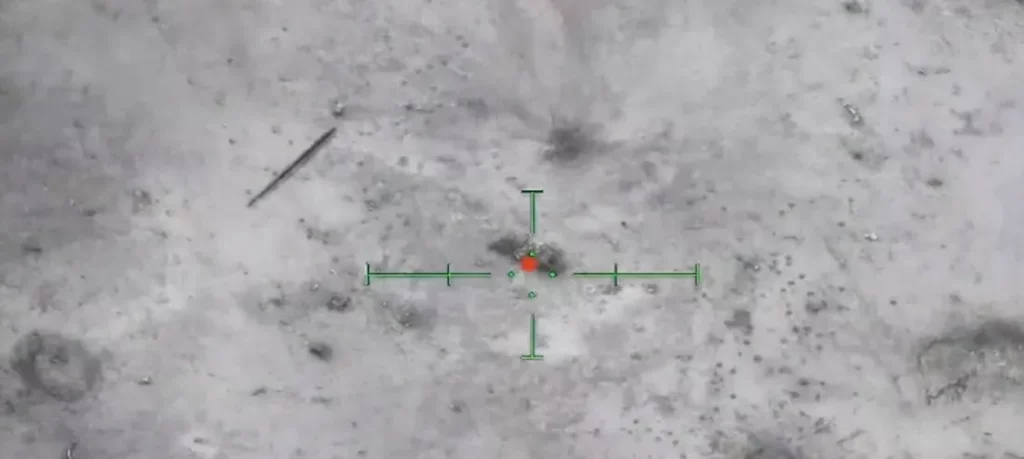
Today, July 10, 2026, the U.S. Department of War released the fourth batch of UAP files here. As I discussed on Face The Nation here, CBS News here and One America News here, the release contains 3 NASA photographs, 14 documents spanning the period between 1948 and 2020, 19 military sensor videos, and 4 NASA audio recordings.
The historical record includes the complete transcript of the February 1949 Los Alamos conference (posted here), following on a request I initiated on behalf of the UAP Science Advisory Council (https://uapsac.com/) that I chair. The 1949 conference was organized by Edward Teller, the Hungarian-American theoretical physicist widely known as the father of the hydrogen bomb, who was a key figure in the Manhattan Project during World War II and a driving force behind the creation of the Lawrence Livermore National Laboratory in California. The conference focused on green fireball reports near Los Alamos and other sensitive atomic sites. Lincoln LaPaz contrasted the events with ordinary meteorite falls and described the Starvation Peak event as sudden, yellow-green, nearly horizontal and lasting about two seconds. The released summary notes that the group did not reach consensus, with shallow meteor entry considered but not settled. Teller appears calculating at the blackboard the properties of the mysterious green fireballs, while laboratory director Norris Bradbury closed the conference with the admission that their horizontal paths and silence remained unexplained. The conference featured participants from the Army, the FBI, the Atomic Energy Commission, the University of New Mexico and the University of California group at Los Alamos, and included Fred Reines who was awarded the Physics Nobel Prize in 1995.
The historic files include a 1948 Top Secret intelligence study reproduces photographs of the Horten flying wing, a tailless German aircraft that looks like a flying disc and whose glider prototype reached 14,200 feet as early as 1938, the study’s conventional explanation for early disc reports.
The released tranche features early Cold War intelligence files, nuclear site records, Navy Range Fouler reports, modern military sensor videos, NASA spaceflight material and Project Blue Book oversight records.
The modern nuclear security highlight is the Pantex incident report from 2015. The report says the Pantex ground surveillance radar detected an unknown object near the plant, that protective force personnel responded under the approved plan for unmanned aerial systems, and that the object was followed north of the plant. Officers reported that it made no sound and that they could not identify a propulsion system with binoculars. The report also says the object seemed to increase speed and change direction while being followed, that security officers tracked it with a camera for three to five minutes at roughly one hundred to two hundred feet above the ground, and that statements, video and other evidence were turned over to the FBI.
Project Sign and Project Blue Book are also represented in important ways. The Project Sign progress report covers one hundred sightings from 1947 and 1948 and gives a direct look at the first organized Air Force study. The Project Blue Book review file documents the 1966 and 1967 Scientific Advisory Board review and its recommendation that the Air Force contract a university affiliated scientific team to investigate selected sightings. Together, these records show a movement from wartime and early Cold War intelligence concern into more formal scientific review.
The Range Fouler reports are among the most important operational records. The newly released debriefs show standardized Navy reporting for unauthorized intrusions into controlled military airspace during active operations or training. One 2020 Eastern United States case tied to PR106 described a very small object moving in a constant direction with a metallic appearance and reflective underside. A 2019 Eastern United States case tied to PR112 included five military affiliated observers and described flight characteristics unlike anything one observer had seen in 28 years of Air Force and Navy service. The Atlantic Ocean case tied to PR116 is more prosaic in tone, describing a darker maroon object around 12 to 15 feet high that travelled with the wind and resembled a large deformed balloon.
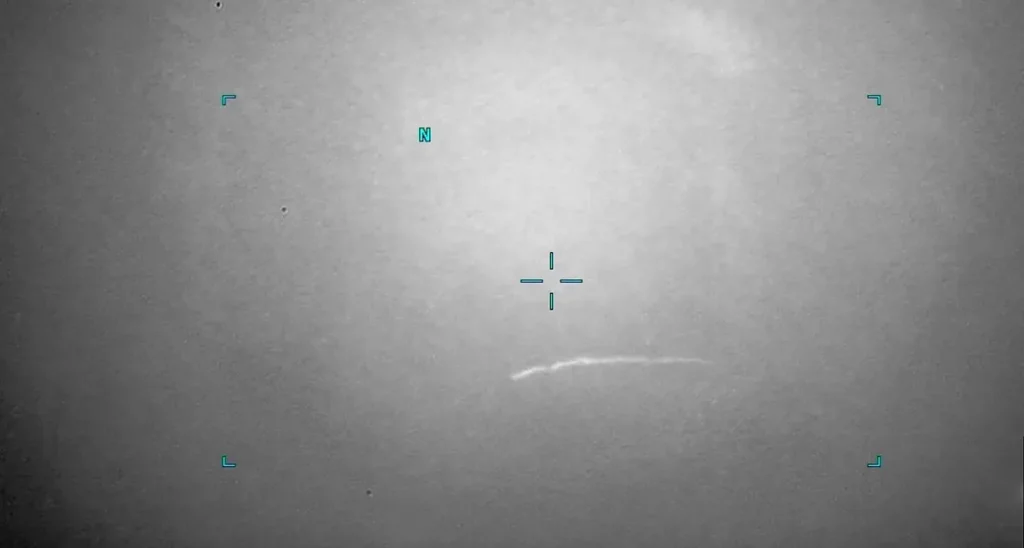
One interesting video shows a 90-degrees change in the motion of a mysterious object which becomes a thin line moving to the bottom left in a video available here. Another video shows a collection of mysterious objects moving in a narrow formation moving to the bottom left in a video released here.
The star-looking shape of an object in one of the videos is simply the diffraction pattern of the camera, namely an optical artifact and not the shape of the source.
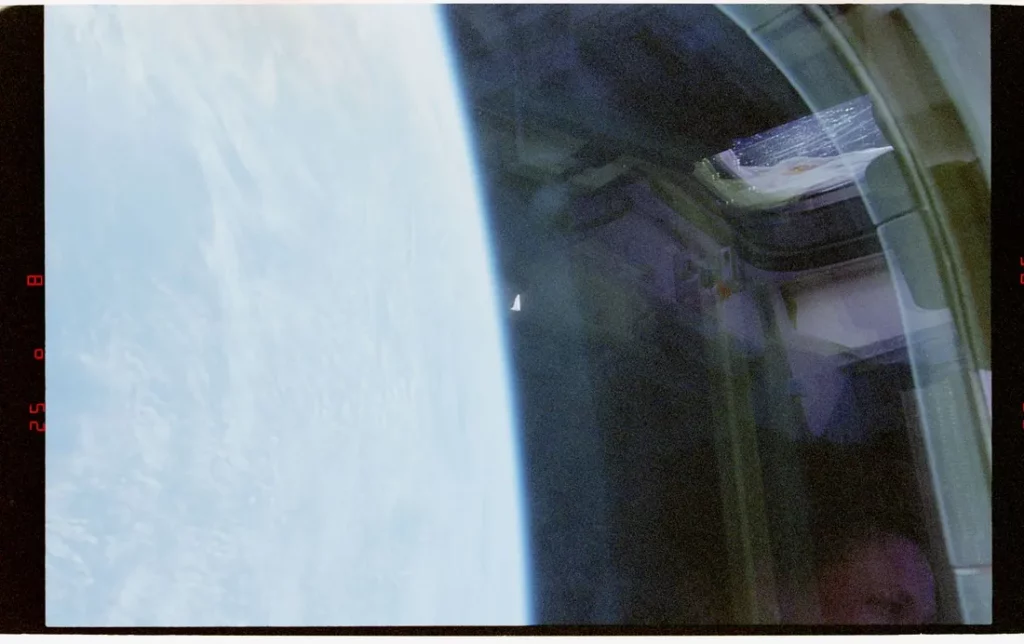
A NASA image shows an unidentified object through a window in low Earth orbit during the 1996 Columbia mission, with the second image description noting that the object appears to have rotated or tumbled in a way consistent with a free-floating object. The unidentified objects appear like a fragment of space trash — likely from a human-made origin. There are about forty thousand fragments larger than 10 centimeters floating around the Earth from broken satellites.
The Apollo 14 and Apollo 17 debriefing records discuss light flash phenomena, now understood as a biological effect caused by high energy cosmic-rays passing through the eye and striking the retina. These records are important because they show how unusual spaceflight observations can be documented without forcing a speculative explanation, as I explained in my essays posted here, here and here.
Thanks to the released files, there is no doubt that mysterious objects were spotted by the U.S. government in the sky. As a citizen of the United States, it is my civil duty to help the White House, the Pentagon, the director of national intelligence and the intelligence community, figure out the nature of UAP. All members of the UAP Science Advisory Council (https://uapsac.com/) resonate with me about that. The council does not need to know the context of where and how the unclassified data was collected. We just need to have enough data to confirm that we are dealing with unusual objects, so that we can analyze their properties and communicate the findings to the scientific community at large. This will undoubtedly have a huge impact on the scientific community and the public.
Stay tuned for what we find!