Este artigo foi escrito originalmente em inglês.
 Ler em Português
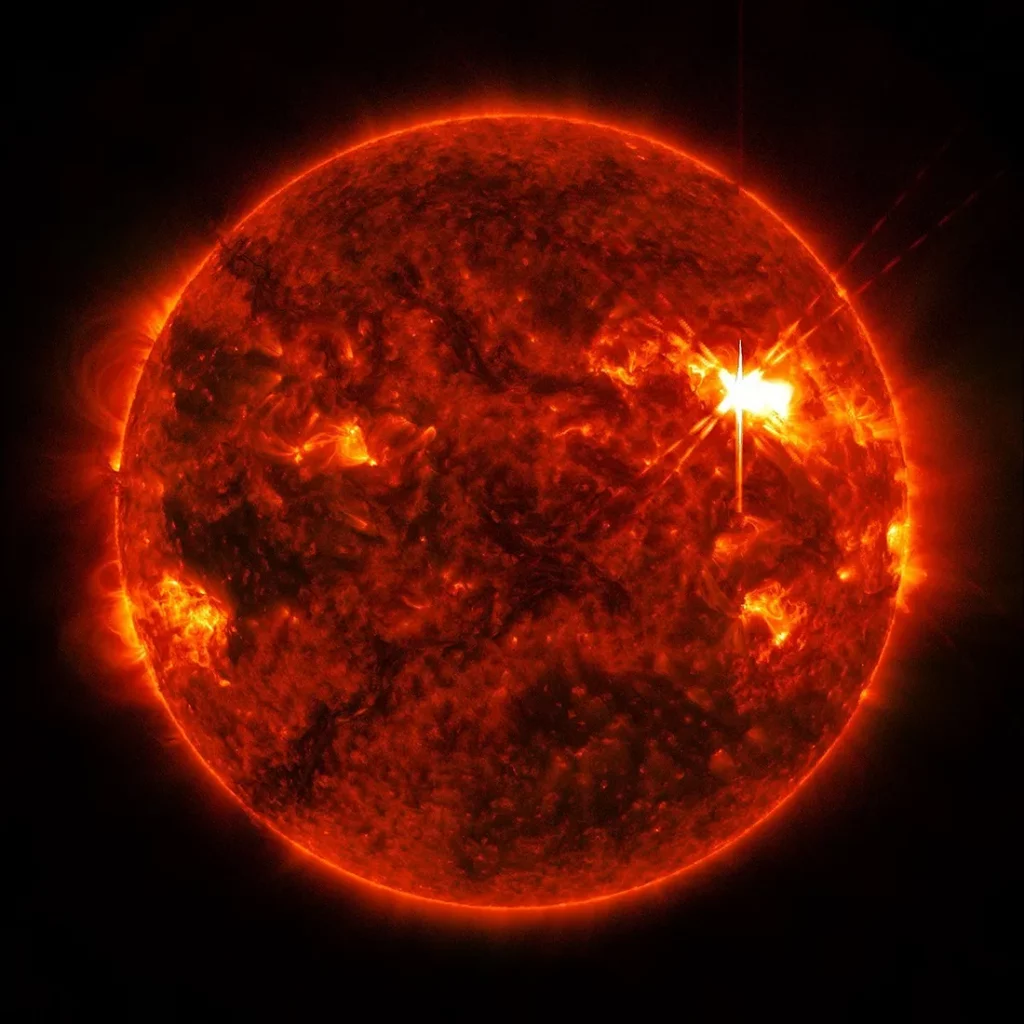
The most abundant stars are dwarf stars with a tenth of the mass of the Sun. They live for trillions of years (as calculated here), over a hundred times longer than the lifespan of the Sun. If intelligent life were common around low-mass stars, we would find ourselves next to a dwarf star in the future because that is the most likely outcome. Why do we exist near the Sun right now, cosmologically speaking?
This is a question that I have asked a decade ago in a paper published in the Journal of Cosmology and Astroparticle Physics, accessible here.
Since dwarf stars are fainter than the Sun, the habitable zone around them — where liquid water may exist on the surface of an Earth-like planet, is closer to the star than the Earth-Sun separation — defined as an Astronomical Unit and abbreviated as AU.
For example, the nearest star to the Sun, Proxima Centauri, has a mass of 0.12 solar masses and a luminosity that is just 0.16% of the solar luminosity. Its habitable zone is between 0.023–0.054 AU (as discussed here), corresponding to an orbital period of 3.6–14 Earth days. A rocky planet orbiting within this zone experiences strong tides that tend to lock its spin period to its orbital period, similarly to the Earth’s Moon. This tidal locking minimizes the energy of the system, and means that the planet will have a permanent dayside and a permanent nightside.
As it turns out, Proxima Centauri hosts two planets within its habitable zone (as reported here): Proxima b with a mass of about 1.1 Earth masses, an orbital radius of 0.05 AU and an orbital time of 11.2 Earth days, and Proxima d with a mass of about 0.26 Earth masses, an orbital radius of 0.029 AU and an orbital period of 5.1 days.
Proxima Centauri exhibits violent flares (as reported here) which can strip the atmospheres of close-in planets like Proxima b or Proxima d. In the absence of an atmosphere, these planets would resemble the current Mars, with no liquid water on their surface. This is because surface water can exist in a liquid phase only in the presence of an external atmospheric pressure. The lack of liquid water would in turn deny Proxima b and Proxima d from the opportunity to develop the chemistry of life-as-we-know-it on their surface. The combination of tidal locking and the lack of an atmosphere to moderate differences in surface temperature, implies a large persistent temperature contrast between the permanent dayside and nightside of these planets.
Massive stars are less abundant than solar-mass stars. They are also brighter and shorter-lived than the Sun. They dominated the energy output of early galaxies when the Universe was younger and comparable in age to their lifespan. We should not be surprised to find ourselves in the Solar System at the current cosmic epoch, because the Sun’s lifespan of 12.2 billion years (as calculated here) is similar to the present age of the Universe, 13.8 billion years. The most likely time to find a system is in the middle of its lifespan.
In a recent paper with my brilliant postdoc, Devesh Nandal, accessible here, we showed that the intense ultraviolet radiation and strong winds of massive stars preclude habitability for the period of time required for complex life to develop on Earth. In particular, a 9 solar mass star sustains a habitable zone for only 30 million years at an orbital radius of about 100 AU, and this brief sliver of potential habitability disappears for stars more massive than 15 solar masses.
In addition, early stars in the infant Universe were marked by a low abundance of heavy elements which are essential for making rocky planets and the carbon-based chemistry of terrestrial life.
These universal considerations give a plausible explanation to why we do not exist near a massive star in the past or near a dwarf star in the future, but rather near a middle-aged star like the Sun at the present cosmic epoch.
Putting politics aside, life could not have been better for us — cosmologically speaking.